
Grind the seating surface only until it is smooth.
NOTICE
Do not grind the seat too much. Overgrinding will reduce valve clearance by sinking the valve into the head. If the valve sinks too far into the head, it will be impossible to adjust the clearance, and the cylinder head must be replaced.
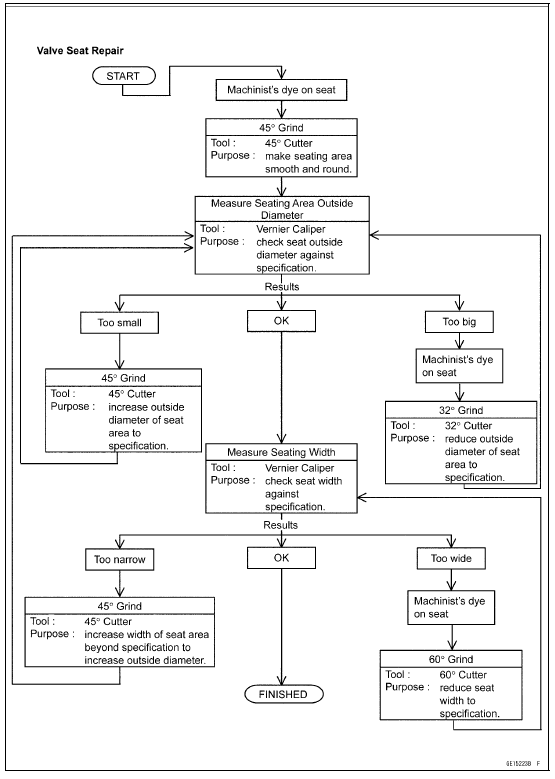
If the outside diameter of the seating surface is too small, repeat the 45° grind until the diameter is within the specified range.
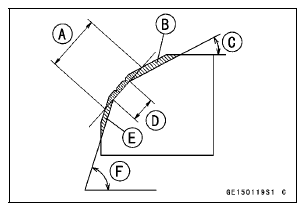
Widened Width [A] of engagement by machining with 45° cutter
Ground Volume [B] by 32° cutter 32° [C]
Correct Width [D]
Ground Volume [E] by 60° cutter 60° [F]
If the outside diameter of the seating surface is too small, repeat the 45° grind [A] until the diameter is within the specified range.
Original Seating Surface [B]
NOTE
If the outside diameter [A] of the seating surface is too large, make the 32° grind described below.
If the outside diameter of the seating surface is within the specified range, measure the seat width as described below.
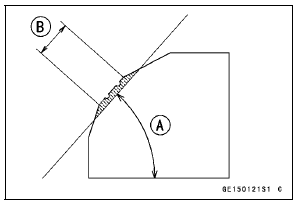
To make the 32° grind, fit a 32° cutter into the holder, and slide it into the valve guide.
Turn the holder one turn at a time while pressing down very lightly. Check the seat after each turn.
NOTICE
The 32° cutter removes material very quickly.
Check the seat outside diameter frequently to prevent overgrinding.
After making the 32° grind, return to the seat outside diameter measurement step above.
If the seat width is too narrow, repeat the 45° grind until the seat is slightly too wide, and then return to the seat outside diameter measurement step above.
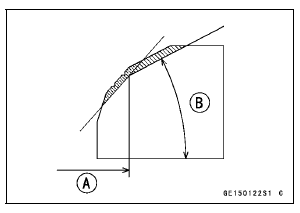
If the seat width is too wide, make the 60° [A] grind described below.
If the seat width is within the specified range, lap the valve to the seat as described below.
To make the 60° grind, fit 60° cutter into the holder, and slide it into the valve guide.
Turn the holder, while pressing down lightly.
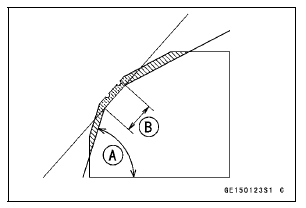
After making the 60° grind, return to the seat width measurement step above.
Correct Width [B]
NOTICE
Do not lap the valve to the valve seat, using the grinding compound. It will come off oxide film treated surface of the valve.
 Seat Cutter Operation Care
Cable Removal
Remove:
Air Cleaner Housing (see Air Cleaner Housing Removal
in the Fuel System (DFI) chapter)
Right Lower Fairing (see Lower Fairing Removal in the
Frame chapter)
Loosen the nuts [A], and slide the lower end of the clutch
cable to give the cable plenty of play.
Screw in the ...
Wheel Rotation Sensor Rotor Inspection
Remove:
Wheels (see Front/Rear Wheel Removal in the
Wheels/Tires chapter)
Brake Disc Mounting Bolts [A]
Sensor Rotor [B]
Front Wheel [C]
Rear Wheel [D]
Visually inspect the wheel rotation sensor rotor.
If the rotor is deformed or damaged (chipped teeth [A]),
replace the ...
Coolant Deterioration Inspection
Remove the right lower fairing (see Lower Fairing Removal
in the Frame chapter).
Visually inspect the coolant in the reserve tank [A].
If whitish cotton-like wafts are observed, aluminum parts
in the cooling system are corroded. If the coolant is
brown, iron or steel parts are rusting. I ...
