
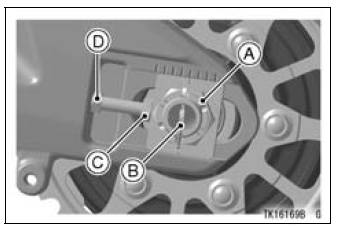
A. Axle Nut
B. Cotter Pin
C. Adjuster
D. Locknut
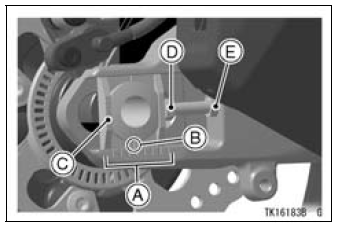
A. Marks
B. Notch
C. Indicator
D. Adjuster
E. Locknut
NOTE
Wheel alignment can also be checked using the straightedge or string method.
| WARNING Misalignment of the wheel will result in abnormalwear, andmay result in an unsafe riding condition. Align the rear wheel using the marks on the swingarm or measuring the distance between the center of the axle and swingarm pivot. |
Tightening Torque
NOTE
If a torque wrench is not available, this item should be serviced by an authorized Kawasaki dealer.
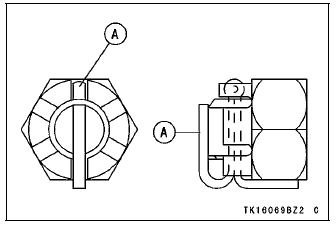
A. Cotter Pin
NOTE
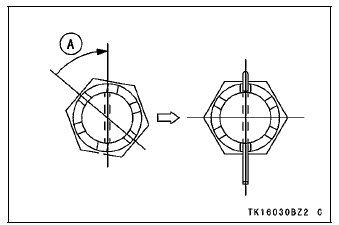
A. Turn Clockwise
| WARNING A loose axle nut can lead to an accident resulting in serious injury or death. Tighten the axle nut to the proper torque and install a new cotter pin. |
 Chain Slack Inspection
 Wear Inspection
Coolant Filling
Remove the bolts and quick rivets.
Detach the tabs and remove the right
fairing and cover.
A. Bolts
B. Quick Rivet
C. Large Quick Rivet
D. Tabs
E. Right Fairing and Cover
NOTE
The right fairing and cover uses the
quick rivets and large quick rivet.
The large quick rivet ca ...
Air Suction System Damage Inspection
Separate the air switching valve hose [A] from the lower
air cleaner housing [B] (see Air Cleaner Housing Removal
in the Fuel System (DFI) chapter).
Connect the following parts temporarily.
Fuel Pump Lead Connector [A]
Extension Tube [B]
Air Cleaner Housing (see Air Cleaner Hou ...
Subthrottle Sensor Input Voltage Inspection
NOTE
Be sure the battery is fully charged.
Turn the ignition switch to OFF.
Remove the air cleaner housing (see Air Cleaner Housing
Removal in the Fuel System (DFI) chapter)
Disconnect the subthrottle sensor connector and connect
the harness adapter [A] between these connectors.
Spec ...