
Use clean, fresh unleaded gasoline with a minimum Antiknock Index of 90.
The Antiknock Index is posted on service
station pumps. The octane rating
of a gasoline is a measure of its resistance
to detonation or “knocking.� The
Antiknock Index is an average of the
Research Octane Number (RON) and
the Motor Octane Number (MON) as
shown in the table.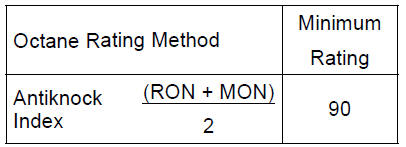
NOTICE
Use minimum of 90 octane gasoline only to prevent severe engine damage.
NOTICE
If engine “knocking� or “pinging� occurs, use a different brand of gasoline of a higher octane rating. If this condition is allowed to continue it can lead to severe engine damage.
Gasoline quality is important.
Fuels of low quality or not meeting standard industry specifications may result in unsatisfactory performance. Operating problems that result from the use of poor quality or nonrecommended fuel may not be covered under your warranty.
 Fuel Tank
 Fuels Containing Oxygenates
ECU Identification
Most countries have their own regulations, so each ECU
has different characteristic. So, do not confuse ECU with
each other and use only the ECU for your model. Otherwise,
the motorcycle can not clear the regulation.
ECU Identification
ZX1000JB/KB
ZX1000JC /KC
...
Rear Fender Front Removal
Remove:
Flap and Rear Fender Rear (see Flap and Rear Fender
Rear Removal)
Fuel Tank (see Fuel Tank Removal in the Fuel System
(DFI) chapter)
Battery (see Battery Removal in the Electrical System
chapter)
Exhaust Butterfly Valve Actuator (see Exhaust Butterfly
Valve Actuator Remova ...
Front, Rear Wheel Rotation Difference Abnormal Inspection (Service Code b
25)
Check the following and correct the faulty part.
Incorrect Tire Pressure
Tires not recommended for the motorcycle were installed
(incorrect tire size).
Deformation of Wheel or Tire
Missing Teeth or Clogging with Foreign Matter of Sensor
Rotor (see Wheel Rotation Sensor Rotor Inspe ...