
NOTICE
Do not lap the valve to the valve seat, using the grinding compound. It will come off oxide film treated surface of the valve.
Valve Stem [A] Oil Seal [B] Spring Seat [C] Closed Coil End [D] Valve Spring [E]: EX - Yellow Paint IN - White Paint (∼ ZX100JBF/KBF Early Models) Purple Paint (ZX100JBF/KBF Late Models ∼) Retainer [F] Split Keepers [G]
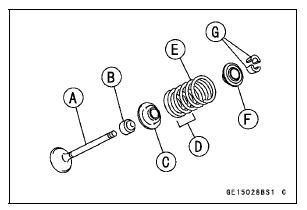
 Valve Removal
 Valve Guide Removal
Rear Shock Absorber Inspection
Press down on the seat several times
to inspect the stroke.
Visually inspect the rear shock absorber
for oil leaks.
If there is any doubt about the rear
shock absorber, it should be inspected
by an authorized Kawasaki
dealer.
A. Rear Shock Absorber
Spring Preload Adjustment
...
Starter Clutch Assembly
Install the one-way clutch [A] to the driven gear.
Face the circlip side of the one-way clutch to inside.
Install the new snap ring [B] to the one-way clutch.
Install the drive gear [C] while turn it counterclockwise [D].
Apply molybdenum disulfide oil solution to the needle
bearing ...
Compression Damping Force Adjustment
There are two adjustments you can make to the compression
damping force.
High Speed Compression Damping Adjuster [A]
Low Speed Compression Damping Adjuster [B]
To adjust the high speed compression damping force, turn
the outside damping adjuster with a wrench to the desired
position ...