
Lubricate the points shown below, with either motor oil or regular grease, in accordance with the Periodic Maintenance Chart or whenever the vehicle has been operated under wet or rainy conditions.
Before lubricating each part, clean off any rusty spots with rust remover and wipe off any grease, oil, dirt, or grime.
NOTE
A few drops of oil are effective to keep bolts and nuts from rusting and sticking. This makes removal easier.
Badly rusted nuts, bolts, etc., should be replaced with new ones.
Apply motor oil to the following pivots
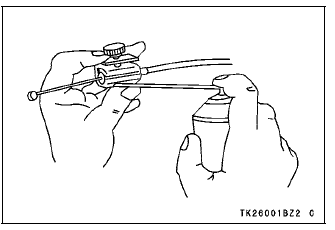
Lubricate the following cables with a pressure cable luber
Apply grease to the following points
(K): Should be serviced by an authorized Kawasaki dealer.
NOTE
After connecting the cables, adjust them.
 Fuses
FusesBalance Weight Installation
Check if the weight portion has any play on the blade [A]
and clip [B].
If it does, discard it.
WARNINGUnbalanced wheels can create an unsafe
riding
condition. If the balance weight has any play on
the rib of the rim, the blade and/or clip have been
stretched. Replace th ...
Stick Coil Primary Peak Voltage Inspection
NOTE
Be sure the battery is fully charged.
Remove the stick coils (see Stick Coil Removal).
Do not remove the spark plugs.
Connect the ECU to the harness.
Measure the primary peak voltage as follows.
Install the new spark plug [A] into each stick coil [B], and
ground them onto ...
Coolant Deterioration Inspection
Remove the right lower fairing (see Lower Fairing Removal
in the Frame chapter).
Visually inspect the coolant in the reserve tank [A].
If whitish cotton-like wafts are observed, aluminum parts
in the cooling system are corroded. If the coolant is
brown, iron or steel parts are rusting. I ...
