
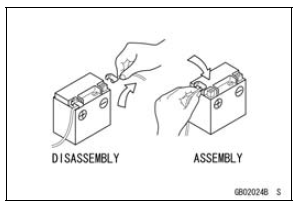
Before completing any service on the motorcycle, disconnect the battery cables from the battery to prevent the engine from accidentally turning over. Disconnect the ground cable (–) first and then the positive (+). When completed with the service, first connect the positive (+) cable to the positive (+) terminal of the battery then the negative (–) cable to the negative terminal.
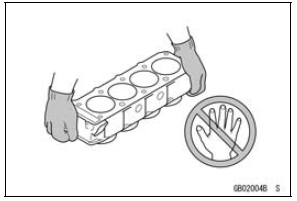
Edges of Parts
Lift large or heavy parts wearing gloves to prevent injury from possible sharp edges on the parts.
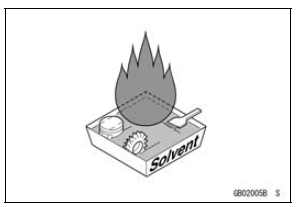
Solvent
Use a high flash-point solvent when cleaning parts. High flash-point solvent should be used according to directions of the solvent manufacturer.
 Before Servicing
 Cleaning Vehicle before Disassembly
Exhaust Butterfly Valve Actuator Installation
Install the pulley [A] on the actuator so that the hole side
[B] align with the groove [C] on the shaft.
Make sure that the groove on the shaft is pointing toward
the center of the screw [D].
If the shaft position is incorrect, refer to the following
NOTE and procedures to electrically ad ...
Inquiries to Rider
Each rider reacts to problems in different ways, so it is important to
confirm what kind of condition
the rider is dissatisfied with.
Try to find out exactly what problem occurs under exactly what
conditions by asking the rider; knowing
this information may help you reproduce the prob ...
Instrument display brightness control
The brightness of the tachometer
LED segments and illumination of the
multifunction meter are controlled automatically
depending on the ambient
brightness.
A. Tachometer
B. Ambient Brightness Sensor
C. Multifunction Meter
NOTE
Be careful not to cover the ambient
brightness sensor on th ...