
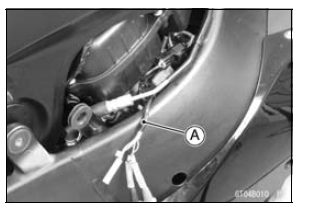
Disconnect the main throttle sensor connector and connect the setting adapter [A] between these connectors.
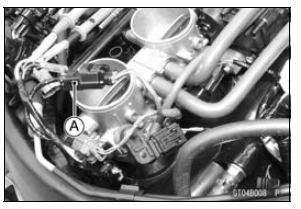
Special Tool - Throttle Sensor Setting Adapter: 57001 -1538
Main Throttle Sensor Output Voltage Connections to Adapter: Digital Meter (+) → R (sensor V/W) lead
Digital Meter (–) → BK (sensor BR/BK) lead
Install the following parts temporarily.
Throttle Body Assy (see Throttle Body Assy Installation in the Fuel System (DFI) chapter) Air Cleaner Housing (see Air Cleaner Housing Installation in the Fuel System (DFI) chapter) Fuel Tank (see Fuel Tank Installation in the Fuel System (DFI) chapter)
Throttle Sensor Setting Adapter [A]
Idle Speed Standard: 1 100 ±50 r/min (rpm)
Output Voltage
Standard: DC 0.64 0.68 V at idle
throttle opening
DC 3.89  4.09 V at full throttle
opening (for
reference)
NOTE
Example: In the case of a input voltage of 4.75 V.
0.64 × 4.75 ÷ 5.00 = 0.61 V
0.68 × 4.75 ÷ 5.00 = 0.65 V
Thus, the valid range is 0.61
0.65 V
If the reading is out of the standard, replace the throttle body assy.
If the reading is within the standard, remove the ECU and check the wiring for continuity between harness connectors.
Special Tool - Hand Tester: 57001-1394
Disconnect the ECU and sensor connectors.
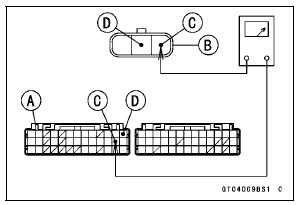
Wiring Continuity Inspection ECU Connector [A] ←→ Main Throttle Sensor Connector [B] V/W lead (ECU terminal 25) [C] BR/BK lead (ECU terminal 13) [D]
If the wiring is good, check the ECU for its ground and power supply (see ECU Power Supply Inspection in the Fuel System (DFI) chapter).
If the ground and power supply are good, replace the ECU (see ECU Removal/Installation in the Fuel System (DFI) chapter).
Main Throttle Sensor Circuit
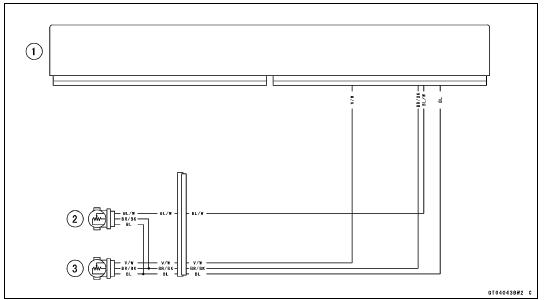
1. ECU
2. Subthrottle Sensor
3. Main Throttle Sensor
 Main Throttle Sensor Resistance Inspection
Braking
Close the throttle completely, leaving
the clutch engaged (except when
shifting gears) so that the engine will
help slow down the motorcycle.
Shift down one gear at a time so that
you are in 1st gear when you come
to a complete stop.
When stopping, always apply both
brakes at the ...
System Components
1. FI ECU
The FI ECU analyzes the motorcycle conditions based
on the signals from the front/rear wheel rotation sensors
and FI sensors (such as the crankshaft sensor and main
throttle sensor), and controls engine power by reducing the
number of ignition and retarding the ignition timing. The
m ...
Location of parts
Clutch Lever
Left Handlebar Switches
Rebound Damping Force Adjuster
(Front Fork)
Compression damping force adjuster
(Front Fork)
Meter Instruments
Brake Fluid Reservoir (Front)
Right Handlebar Switches
Front Brake Lever
Throttle Grip
Ignition Switch/Steering Lock
Elect ...
