
NOTE
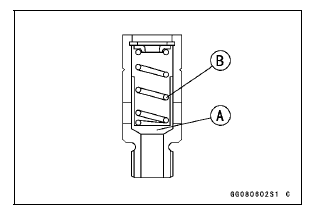
Inspect the valve in its assembled state. Disassembly and assembly may change the valve performance.
If any rough spots are found during above inspection, wash the valve clean with a high flash-point solvent and blow out any foreign particles that may be in the valve with compressed air.
| WARNING Gasoline and low flash-point solvents can be flammable and/or explosive and cause severe burns. Clean the relief valve in a well-ventilated area, and take care that there is no spark or flame anywhere near the working areas. Do not use gasoline or low flash-point solvents to clean the relief valve. |
If cleaning does not solve the problem, replace the oil pressure relief valve as an assembly. The oil pressure relief valve is precision made with no allowance for replacement of individual parts.
 Oil Pressure Relief Valve Installation
 Oil Pump
Brake Pedal Installation
Apply grease to the brake pedal pivot shaft [A].
Install:
Washers [B]
Brake Pedal [C]
Apply a non-permanent locking agent to the threads of
the brake pedal mounting bolt [D], and tighten it.
Torque - Brake Pedal Mounting Bolt: 8.8 N·m (0.90 kgf·m,
78 in·lb)
Install the re ...
Instrument display brightness control
The brightness of the tachometer
LED segments and illumination of the
multifunction meter are controlled automatically
depending on the ambient
brightness.
A. Tachometer
B. Ambient Brightness Sensor
C. Multifunction Meter
NOTE
Be careful not to cover the ambient
brightness sensor on th ...
Master Cylinder Rubber Parts Replacement
Front Master Cylinder Disassembly
Remove the front master cylinder (see Front Master Cylinder
Removal in the Brakes chapter).
Remove the seal cover [A], circlip [B], connector [C] and
O-ring [D].
Special Tool - Inside Circlip Pliers: 57001-143
Unscrew the locknut [E] and pivot bolt ...