
The Power mode determines the engine power output characteristics and has three settings.
The S-KTRC and the Power mode can be set separately. By combining each setting, the rider can get various power feelings to suit riding conditions or individual preference.
Mode F (Full Power):
The highest engine power output is achieved. The rider can feel the full throttle response of the engine.
Mode M (Middle Power):
The throttle response is less sharp compared to the mode F.
Depending throttle application full power can be accessed temporarily.
Mode L (Low Power):
About 60% of the highest engine power output is achieved. The throttle response is mildest among the three modes.
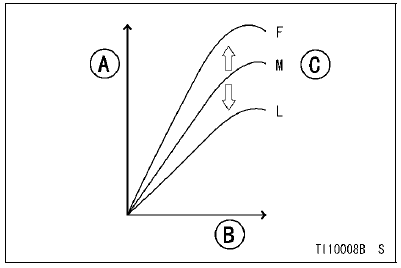
A. Power
B. Engine rpm
C. Depending on Throttle Angle
Power mode Button
For the power mode setting, use the power mode button on the left handlebar switch.
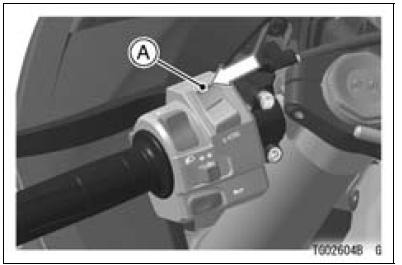
A. Power mode Button (Upper Part)
Power mode setting
Themode can be changed only when the throttle grip is closed completely.
NOTE
When changing the mode, stop the motorcycle.
 0.4
0.4
NOTE
 Sport-kawasaki traction control (s-ktrc)
 Safe operation
Front Forks/Rear Shock Absorber Operation Inspection
Pump the forks down and up [A] 4 or 5 times, and inspect
the smooth stroke.
If the forks do not smoothly or noise is found, inspect the
fork oil level or fork clamps (see Front Fork Oil Change in
the Suspension chapter).
Pump the rear seat down and up [A] 4 or 5 times, and
inspec ...
Charging Voltage Inspection
Check the battery condition (see Charging Condition Inspection).
Warm up the engine to obtain actual alternator operating
conditions.
Remove the front seat (see Front Seat Removal in the
Frame chapter).
Check that the ignition switch is turned off, and connect
the hand tester [A] to t ...
CAN Communication (Transmission)/CAN Bus OFF Monitor Inspection (Service Code
b 57) CAN Communication (Reception) Monitor Inspection (Service Code b 58)
Remove:
Seat (see Seat Removal in the Frame chapter)
Immobilizer (Equipped Models)/Kawasaki Diagnostic
System Connector Cap [A]
Measure the CAN communication line resistance.
Immobilizer (Equipped Models)/Kawasaki Diagnostic
System Connector [A]
GY/BL Terminal [B]
LB Ter ...