
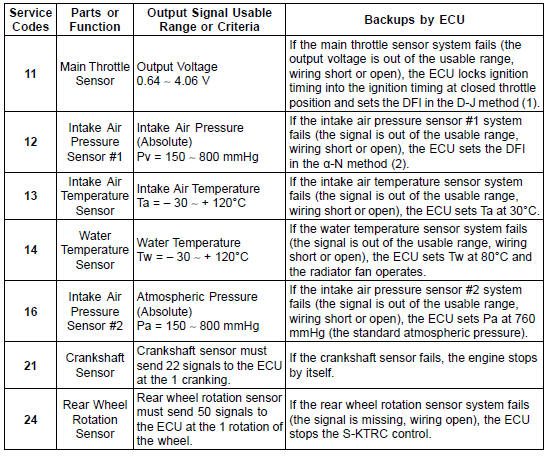
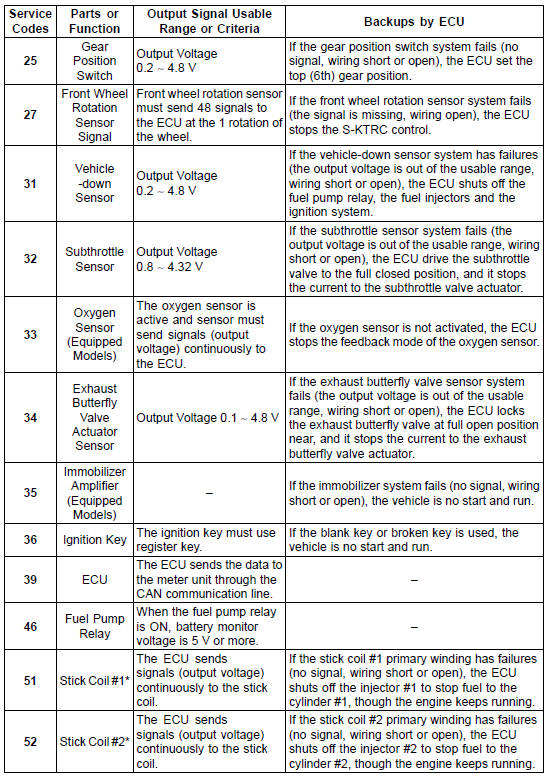
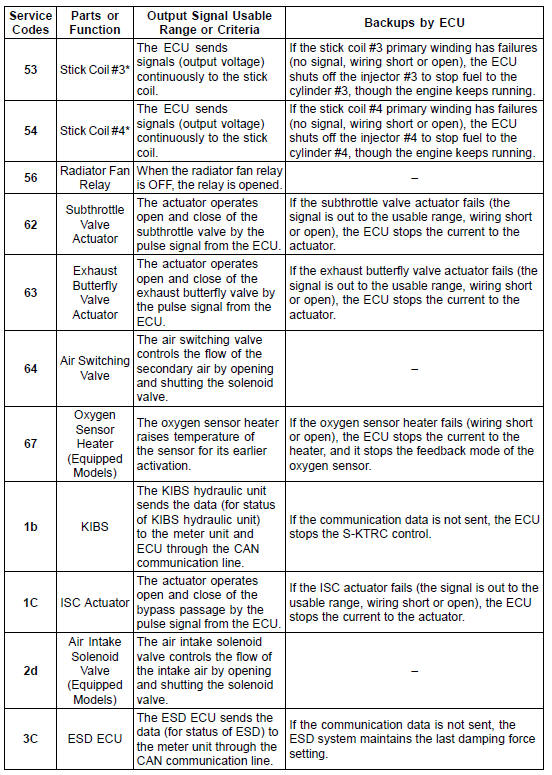
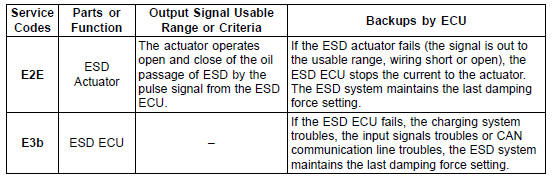
Note:
(1): D-J Method: When the engine load is light like at idling or low speed, the ECU determines the injection quantity by calculating from the throttle vacuum (vacuum sensor output voltage) and engine speed (crankshaft sensor output voltage). This method is called D-J method.
(2): α-N Method: As the engine speed increases, and the engine load turns middle to heavy, the ECU determines the injection quantity by calculating from the throttle opening (throttle sensor output voltage) and the engine speed. This method is called α-N method.
*: This depends on the number of stopped cylinders.
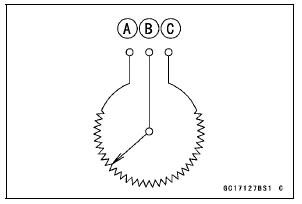
The main throttle sensor is a rotating variable resistor that change output voltage according to throttle operating. The ECU senses this voltage change and determines fuel injection quantity, and ignition timing according to engine rpm, and throttle opening.
Input Terminal [A]: BL Output Terminal [B]: V/W Ground Terminal [C]: BR/BK
 Service Code Erasing
Electronic Steering Damper Warning Indicator Light
The yellow light functions as the
electronic steering damper warning indicator.
The light and warning symbol
"ESD" go on if there is a malfunction in
the electronic steering damper system.
However, this could also be caused by
trouble with the charging system (e.g.
battery). I ...
Water Pump Housing Disassembly
NOTICE
Do not damage the hole wall of the water pump
housing.
Insert a bar [A] into the pump housing [B], and hammer
evenly around the circumference of the mechanical seal
bottom [C].
Take the oil seal [A] out of the housing [B] with a hook [C].
...
Wiring Diagram (Other than US, CA and CAL without KIBS Models)
ZX1000JC
ZX1000JD
...
