
Special Tool - Hand Tester: 57001-1394
Charging Voltage 
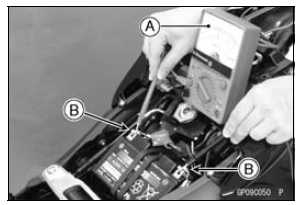
If the charging voltage is kept between the values given in the table, the charging system is considered to be working normally.
If the charging voltage is much higher than the values specified in the table, the regulator/rectifier is defective or the regulator/rectifier leads are loose or open.
If the charging voltage does not rise as the engine speed increases, then the regulator/rectifier is defective or the alternator output is insufficient for the loads. Check the alternator and regulator/rectifier to determine which part is defective.
 Alternator Rotor Installation
 Alternator Inspection
Parking
WARNINGOperating or parking the vehicle
near flammable materials can
cause a fire, and can result in
property damage or severe personal
injury.
Do not idle or park your vehicle
in an area where tall or dry vegetation,
or other flammable materials
could come into cont ...
Parts Location
NOTE
The front and rear wheel rotation sensors and rotors are
standard parts of this motorcycle.
Front Wheel Rotation Sensor [A]
Front Wheel Rotation Sensor Rotor [B]
Rear Wheel Rotation Sensor [C]
Rear Wheel Rotation Sensor Rotor [D]
ABS Indicator Light (LED) [E]
KIBS Indicator Ligh ...
Spring Plate Free Play Measurement
Insufficient clutch free play will cause the engine braking
effect to be more sudden, resulting in rear wheel hop. On
the other hand, if the free play is excessive, the clutch lever
may feel “spongy� or pulsate when pulled.
Hold an extra drive shaft in a vise and install the following
c ...