
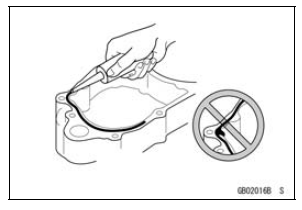
For applications that require Liquid Gasket or a Non-permanent Locking Agent, clean the surfaces so that no oil residue remains before applying liquid gasket or non-permanent locking agent. Do not apply them excessively.
Excessive application can clog oil passages and cause serious damage.
Press
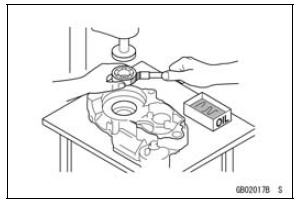
For items such as bearings or oil seals that must be pressed into place, apply small amount of oil to the contact area. Be sure to maintain proper alignment and use smooth movements when installing.
 Gasket, O-ring
 Ball Bearing and Needle Bearing
Wheels
Tubeless tires are installed on the
wheels of this motorcycle. The indications
of “TUBELESS� on the tire side
wall and the rim show that the tire and
rim are specially designed for tubeless
use.
A. “TUBELESS� Mark
A. “TUBELESS� Mark
The tire and rim form a leakproof unit
by ...
Check 3-5: Warning Indicator Light (Red LED) (Oil Pressure Warning)
Inspection
Connect the leads in the same circuit as Check 3-2.
Connect the terminal [10] to the battery (–) terminal.
Check that the oil pressure warning symbol [A] and the
warning indicator light (Red LED) [B] go on.
If the indicator light does not go on, replace the meter unit.
...
External Shift Mechanism Removal
Remove:
Shift Lever (see Shift Pedal Removal)
Oil Pump Drive Gear (see Oil Pump Drive Gear Removal/
Installation in the Engine Lubrication System
chapter)
Circlip [A]
Washer [B]
Special Tool - Outside Circlip Pliers: 57001-144
Remove:
Shift Shaft Assembly [A]
Washer [B] ...