
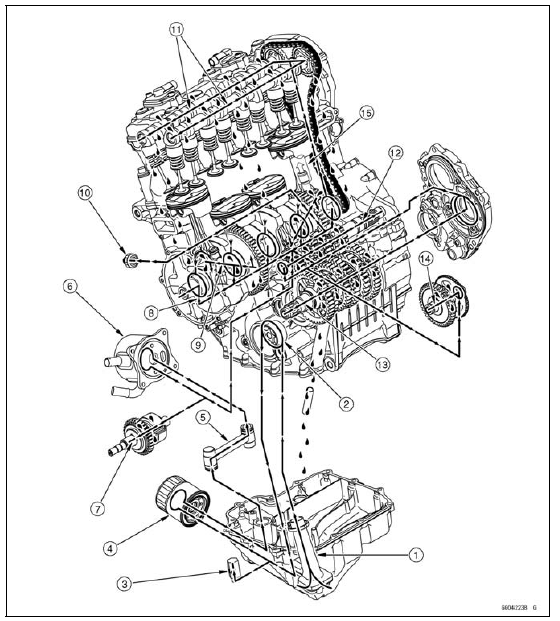
1. Oil Screen
2. Oil Pump
3. Oil Pressure Relief Valve
4. Oil Filter
5. Oil Pipe
6. Oil Cooler
7. Balancer Oil Passage
8. Main Oil Passage
9. Crankshaft Oil Passage
10. Oil Pressure Switch
11. Camshaft Oil Passages
12. Drive Shaft Oil Passage
13. Output Shaft Oil Passage
14. Starter Clutch Oil Passage
15. Blowby Gas (Crankcase → Air Cleaner Housing)
Specifications
 Exploded View
 Special Tools and Sealant
Radiator Cap Inspection
Remove:
Radiator Cap (see Coolant Change in the Periodic Maintenance
chapter)
Check the condition of the bottom [A] and top [B] valve
seals and valve spring [C].
If any one of them shows visible damage, replace the cap
with a new one.
Install the cap [A] on a cooling system pr ...
KIBS Hydraulic Unit Terminal Names
1. Ground: BK
2. CAN Communication Line (High): GY/BL
3. Front Wheel Rotation Sensor Signal Input: Y
4. Power Supply: BR/W
5. KIBS Kawasaki Self-Daignosis System Terminal: P
6. Front and Rear Brake Light Switch Signal: BL/R
7. Unused
8. Front Wheel Rotation Sensor Signal Output: G/Y
9. P ...
Race Mode Display
This mode gives priority to reading
the gear position rather than the
speedometer reading.
The gear position indicator can
be displayed at the position of the
speedometer on the normal mode.
Also the speedometer is displayed instead
of the clock on the normal mode.
This mode can be used ...