
NOTE
Be sure the battery is fully charged.
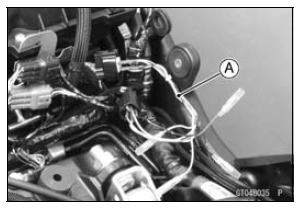
Main Harness [B] Oxygen Sensor [C]
Special Tool - Measuring Adapter: 57001-1700
Oxygen Sensor Heater Power Source Voltage Connections to Adapter: Digital Meter (+) → R (main harness W/R) lead Digital Meter (–) → Frame Ground terminal
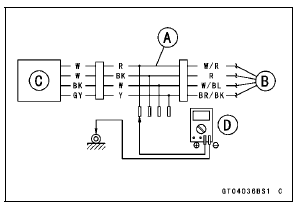
Power Source Voltage Standard: Battery Voltage
If the reading is in specification, but the problem still exists, replace the ECU (see ECU Removal/Installation in the Fuel System (DFI) chapter).
If the reading is out of the standard, check the following.
ECU Relay Fuse 15 A (see Fuse Inspection in the Electrical System chapter) Power Source Wiring (see Oxygen Sensor Circuit)
If the fuse and wiring are good, remove the ECU and check the wiring for continuity between harness connectors.
Special Tool - Hand Tester: 57001-1394
Disconnect the ECU and sensor connectors.
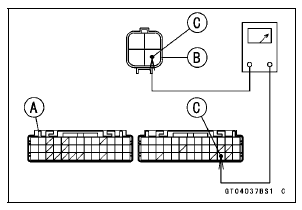
Wiring Continuity Inspection ECU Connector [A] ←→ Oxygen Sensor Connectors [B] R lead (ECU terminal 76) [C]
If the wiring is good, check the ECU for its ground and power supply (see ECU Power Supply Inspection in the Fuel System (DFI) chapter).
If the ground and power supply are good, replace the ECU (see ECU Removal/Installation in the Fuel System (DFI) chapter).
Oxygen Sensor Circuit
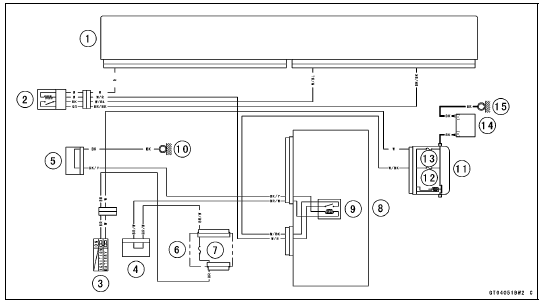
1. ECU
2. Oxygen Sensor
3. Ignition Switch
4. Joint Connector F
5. Joint Connector A
6. Fuse Box 1
7. Ignition Fuse 15 A
8. Relay Box
9. ECU Main Relay
10. Frame Ground 3
11. Starter Relay
12. ECU Fuse 15 A
13. Main Fuse 30 A
14. Battery
15. Engine Ground
 Oxygen Sensor Heater Resistance Inspection
 KIBS Hydraulic Unit Communication Error (Service Code 1b, KIBS Equipped
Models)
KIBS Hydraulic Unit Communication Error (Service Code 1b, KIBS Equipped
Models)Crankcase Splitting
Remove the engine (see Engine Removal in the Engine
Removal/Installation chapter).
Set the engine on a clean surface and hold the engine
steady while parts are being removed.
Remove:
Cylinder Head (see Cylinder Head Removal in the Engine
Top End chapter)
Starter Motor (see Starter M ...
Special Tools and Sealant
Compression Gauge, 20 kgf/cm²:
57001-221
Valve Spring Compressor Assembly:
57001-241
Valve Spring Compressor Adapter,
25:
57001-1019
Valve Seat Cutter, 45° - 27.5:
57001-1114
Valve Seat Cutter, 45° - 32:
57001-1115
Valve Seat Cutter, 32° - 28:
57001-1119
Valve Seat Cutter ...
Parking
WARNINGOperating or parking the vehicle
near flammable materials can
cause a fire, and can result in
property damage or severe personal
injury.
Do not idle or park your vehicle
in an area where tall or dry vegetation,
or other flammable materials
could come into cont ...