
NOTE
The free play adjustment is performed by replacing the steel plate(s).
Spring Plate Free Play
Usable Range: 0.05  0.70 mm (0.002
 0.028 in.)
Replace the following steel plate(s).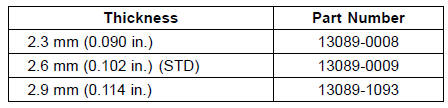
NOTE
Do not use the steel plate of 2.3 mm (0.090 in.) and 2.9 mm (0.114 in.) thickness at the same time.
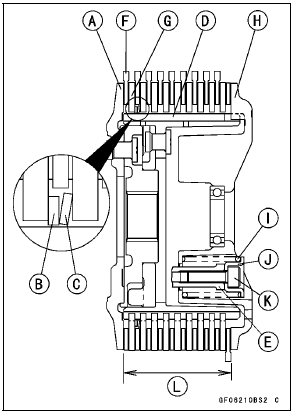
Clutch Plate Assembly Length (Reference Information)
Clutch Hub [A] Spring Seat [B] Spring [C] Sub Clutch Hub [D] Sub Clutch Hub Bolts [E] New Friction Plates [F] Steel Plates [G] Spring Plate [H] Clutch Springs [I] Clutch Spring Holders [J] Clutch Spring Bolts [K]
Torque - Clutch Spring Bolts: 11 N·m (1.1 kgf·m, 97 in·lb)
Clutch Plate Assembly Length (Reference) 53.5 mm (2.11 in.)
NOTE
The length of the clutch plate assembly changes by the steel plate thickness.
 Spring Plate Free Play Measurement
 Clutch Plate, Wear, Damage Inspection
Idle Speed Control Valve Actuator Removal
NOTICE
Never drop the idle speed control valve actuator especially
on a hard surface. Such a shock to the actuator
can damage it.
Remove:
Throttle Body Assy (see Throttle Body Assy Removal in
the Fuel System (DFI) chapter)
Idle Speed Control Valve Actuator Retainer Screws [A]
Idle Spe ...
Payload and Tire Pressure
Failure to maintain proper inflation
pressures or observe payload limits for
your tires may adversely affect handling
and performance of yourmotorcycle
and can result in loss of control. The
maximum recommended load in addition
to vehicle weight is 180 kg (397 lb),
including rider, passenger, ...
Wheel/Tire Damage Inspection
Remove any imbedded stones [A] or other foreign particles
[B] from tread.
Visually inspect the tire for cracks and cuts, and replace
the tire if necessary. Swelling or high spots indicate internal
damage, requiring tire replacement.
Visually inspect the wheel for cracks, cuts and dents ...