
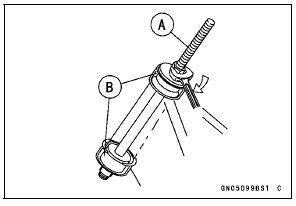
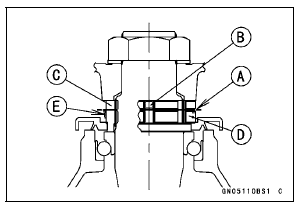
Special Tools - Head Pipe Outer Race Press Shaft [A]: 57001-1075
Head Pipe Outer Race Driver, 
55 [B]: 57001
-1446 or Bearing Driver Set: 57001-1129
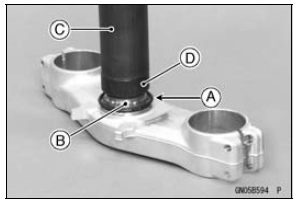
Special Tools - Steering Stem Bearing Driver,
 42.5 [C]:
57001-1344
Steering Stem Bearing Driver Adapter,

41.5 [D]: 57001-1345
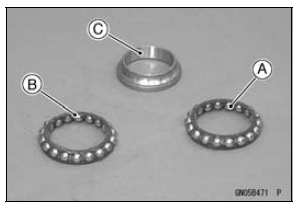
The lower and upper ball bearings are identical.
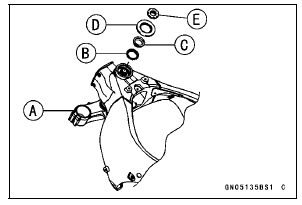
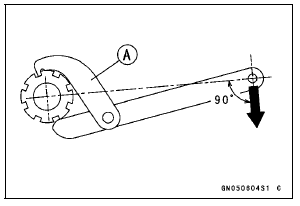
Tighten the steering stem nut with 55 N·m (5.6 kgf·m, 41 ft·lb) of torque first, and loosen it a fraction of a turn until it turns lightly. Afterward tighten it again with specified torque using a steering stem nut wrench [A].
Check that there is no play and the steering stem turns smoothly without rattles. If not, the steering stem bearings may be damaged.
Special Tool - Steering Stem Nut Wrench: 57001-1100
Torque - Steering Stem Nut: 20 N·m (2.0 kgf·m, 15 ft·lb)
NOTE
Torque - Front Fork Clamp Bolts (Upper): 20 N·m (2.0 kgf·m, 15 ft·lb) Steering Stem Head Nut: 78 N·m (8.0 kgf·m, 58 ft·lb) Front Fork Clamp Bolts (Lower): 23 N·m (2.3 kgf·m, 17 ft·lb) Handlebar Clamp Bolts: 25 N·m (2.5 kgf·m, 18 ft·lb)
| WARNING If the handlebar does not turn to the steering stop it may cause an accident resulting in injury or death. Be sure the cables, harnesses and hoses are routed properly and do not interfere with handlebar movement (see Cable, Wire, and Hose Routing section in the Appendix chapter). |
Steering Stem Bearing Lubrication
 Stem, Stem Bearing Removal
 Steering Stem Warp Inspection
Warning Symbols
: The red
warning indicator light
and the oil pressure warning symbol
( )
goes on whenever the oil pressure
is dangerously low or the ignition switch is in the “ON� position with the
engine not running, and go off when the
engine oil pressure is high enough. Refer
to the Mainten ...
Check 3-5: Warning Indicator Light (Red LED) (Oil Pressure Warning)
Inspection
Connect the leads in the same circuit as Check 3-2.
Connect the terminal [10] to the battery (–) terminal.
Check that the oil pressure warning symbol [A] and the
warning indicator light (Red LED) [B] go on.
If the indicator light does not go on, replace the meter unit.
...
Multifunction Display
The multifunction display indicates
the following modes.
Odometer
Trip meter A
Trip meter B
Current Mileage
Average Mileage
Fuel Consumption
Stop Watch
These display modes can be shifted
by pushing the upper button.
NOTE
The “FUEL� warning can be indicated
if the ...