
Do not remove pressed oil or grease seals unless removal is necessary. Replace with new ones whenever removed.
Press new oil seals with manufacture and size marks facing out. Make sure the seal is aligned properly when installing.
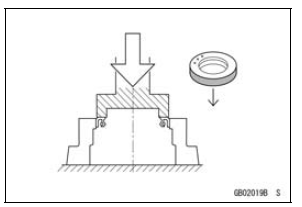
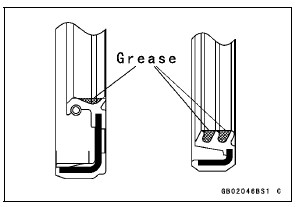
Apply specified grease to the lip of seal before installing the seal.
Circlips, Cotter Pins
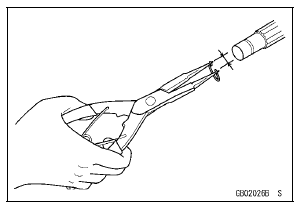
Replace the circlips or cotter pins that were removed with new ones. Take care not to open the clip excessively when installing to prevent deformation.
 Ball Bearing and Needle Bearing
 Lubrication
Air Cleaner Housing Removal
Remove the fuel tank (see Fuel Tank Removal).
Disconnect the secondary fuel hose [A] from the delivery
pipe of the nozzle assy [B] (see Fuel Hose Replacement
in the Periodic Maintenance chapter).
Disconnect the secondary fuel injector connectors [C].
Free the lead from the grooves [D].
...
Connecting Rod Bend Inspection
Remove the connecting rod big end bearing inserts, and
reinstall the connecting rod big end cap.
Select an arbor [A] of the same diameter as the connecting
rod big end, and insert the arbor through the connecting
rod big end.
Select an arbor of the same diameter as the piston pin
and ...
Torque Limiter Installation
Apply molybdenum disulfide grease to the torque limiter
shaft [A].
Install the torque limiter [B], the collar [C] and the shaft.
Turn the large-hole end of the shaft to inside as shown in
the figure.
Replace the washer [D] with a new one.
Apply a non-permanent locking agent to the t ...