
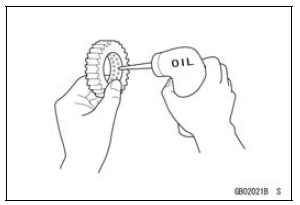
It is important to lubricate rotating or sliding parts during assembly to minimize wear during initial operation. Lubrication points are called out throughout this manual, apply the specific oil or grease as specified.
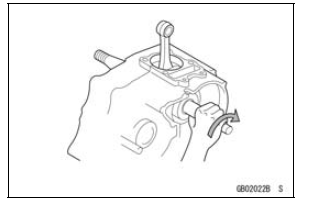
Direction of Engine Rotation
When rotating the crankshaft by hand, the free play amount of rotating direction will affect the adjustment. Rotate the crankshaft to positive direction (clockwise viewed from output side).
 Oil Seal, Grease Seal
 Electrical Leads
Crankcase Splitting
Remove the engine (see Engine Removal in the Engine
Removal/Installation chapter).
Set the engine on a clean surface and hold the engine
steady while parts are being removed.
Remove:
Cylinder Head (see Cylinder Head Removal in the Engine
Top End chapter)
Starter Motor (see Starter M ...
Steering Damper Installation
Install the following parts as shown in the figure.
Collar [A]
Washer (t = 3.5 mm, 0.14 in.) [B]
Steering Damper [C] (
ZX1000JC/KC)
Electronic Steering Damper [D] (ZX1000JD/KD)
Washer (t = 1.2 mm, 0.05 in.) [E]
Apply a non-permanent locking agent to the threads of
the steering ...
Front Fork Disassembly
Remove the front fork (see Front Fork Removal (Each
Fork Leg))
Drain the fork oil (see Front Fork Oil Change).
Take the dust seal [A] off the outer tube.
Remove the retaining ring [B].
Separate the outer tube from the inner tube.
Remove the following parts from the inner tube. ...