
| WARNING Fuel is flammable and explosive under certain conditions and can cause severe burns. Be prepared for fuel spillage; any spilled fuel must be completely wiped up immediately. When the fuel hose is disconnected, fuel spills out from the hose and the pipe. Cover the hose connection with a clean shop towel to prevent fuel spillage. |
For Primary Fuel Hose (Fuel Tank
 Throttle Body Assy)
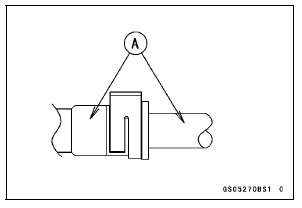
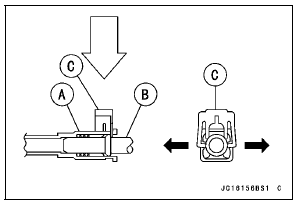
When removing with standard tip screwdriver
When removing with fingers
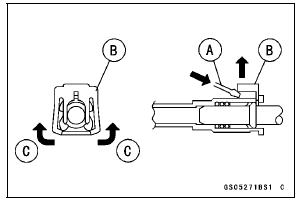
NOTICE
Prying or excessively widening the joint lock ends for fuel hose removal will permanently deform the joint lock, resulting in a loose or incomplete lock that may allow fuel to leak and create the potential for a fire explosion. To prevent fire or explosion from a damaged joint lock, do not pry or excessively widen the joint lock ends when removing the fuel hose. The joint lock has a retaining edge that locks around the housing.
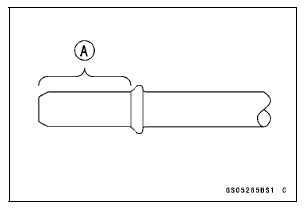
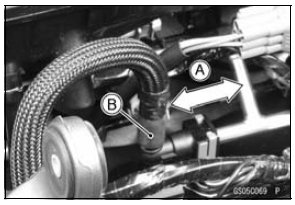
The fuel hose in Brazil model has yellow paint [B].
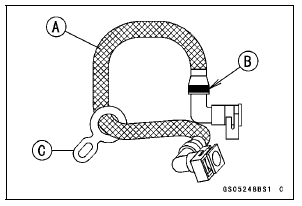
Check the yellow paint of the fuel hose in the throttle body assy side (Brazil model only).
| WARNING Leaking fuel can cause a fire or explosion resulting in severe burns. Make sure the fuel hose joint is installed correctly on the delivery pipe and that it doesn’t leak. |
If it comes off, reinstall the hose joint.
For Secondary Fuel Hose (Throttle Body Assy
 Nozzle Assy)
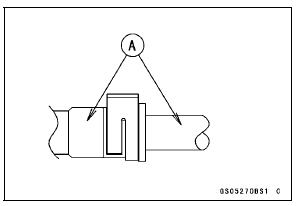
When removing with standard tip screwdriver
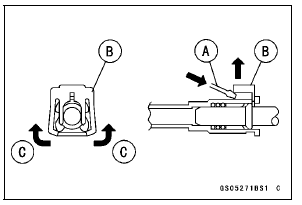
When removing with fingers
NOTICE
Prying or excessively widening the joint lock ends for fuel hose removal will permanently deform the joint lock, resulting in a loose or incomplete lock that may allow fuel to leak and create the potential for a fire explosion. To prevent fire or explosion from a damaged joint lock, do not pry or excessively widen the joint lock ends when removing the fuel hose. The joint lock has a retaining edge that locks around the housing.
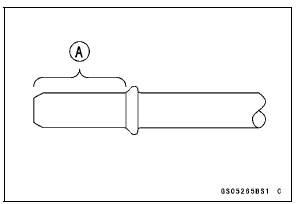
The fuel hose in Brazil model has yellow paint [B].
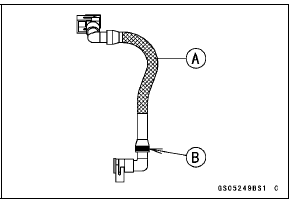
Check the yellow paint of the fuel hose in the throttle body assy side (Brazil model only).
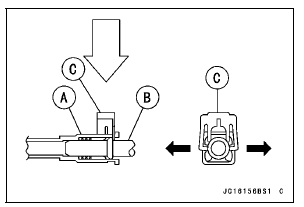
| WARNING Leaking fuel can cause a fire or explosion resulting in severe burns. Make sure the fuel hose joint is installed correctly on the delivery pipe and that it doesn’t leak. |
If it comes off, reinstall the hose joint.
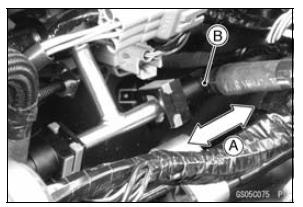
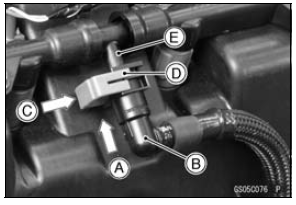
NOTICE
When inserting the fuel hose joint, do not apply strong force to the delivery pipe [E] on the nozzle assy. The pipe made from resin could be damaged.
NOTICE
When pushing and pulling the fuel hose joint, do not apply strong force to the delivery pipe [C] on the nozzle assy. The pipe made from resin could be damaged.
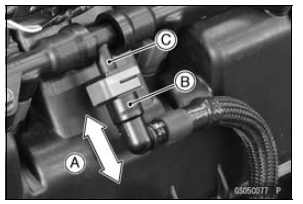
| WARNING Leaking fuel can cause a fire or explosion resulting in severe burns. Make sure the fuel hose joint is installed correctly on the delivery pipe and that it doesn’t leak. |
If it comes off, reinstall the hose joint.
 Air Cleaner Element Replacement
 Coolant Change
Footpeg
Footpeg Height Adjustment
The front footpeg can be adjusted within 2 positions in
height to suit the rider’s preference.
Footpeg [A]
Bolts [B]
Bolt Holes [C]
Footpeg Position 1 [D]
Footpeg Position 2 [E]
Remove the bolts [A].
Adjust the footpeg height.
NOTE
In ...
Tire Repair
Currently two types of repair for tubeless tires have come
into wide use. One type is called a temporary (external) repair
which can be carried out without removing the tire from
the rim, and the other type is called permanent (internal)
repair which requires tire removal. It is generally unders ...
Diode Circuit Inspection
Remove the relay box (see Relay Box Removal).
Check conductivity of the following pairs of terminals (see
Relay Box Internal Circuit in this section).
Diode Circuit Inspection
The resistance should be low in one direction and more
than 10 times as much in the other direction. If any dio ...