
NOTE
Check the wheel alignment (see Wheel Alignment Inspection).
Rotate the rear wheel to find the position where the chain is tightest.
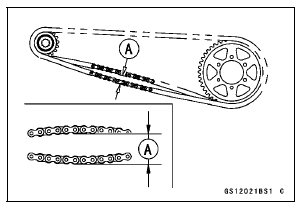
Measure the vertical movement (chain slack) [A] midway between the sprockets.
If the chain slack exceeds the standard, adjust it.
Chain Slack
Standard: 25  35 mm (1.0
 1.4 in.)
 Drive Chain Lubrication Condition Inspection
 Drive Chain Slack Adjustment
Fuel Pump Operating Voltage Inspection
NOTE
Be sure the battery is fully charged.
Turn the ignition switch to OFF.
Remove:
Fuel Tank Bolts (see Fuel Tank Removal)
Fuel Tank Bracket Bolts (see Fuel Tank Removal)
Disconnect the fuel pump lead connector and connect the
harness adapter [A] between these connectors as shown
i ...
For Primary Fuel Injectors
Remove the air cleaner housing (see Air Cleaner Housing
Removal).
Disconnect the injector connector and connect the harness
adapter [A] between these connectors as shown in
the figure.
Main Harness [B]
Primary Fuel Injector #1 [C]
Special Tool - Measuring Adapter: 57001-1700
...
Starter Clutch Installation
Replace the O-ring [A] with a new one and apply grease.
Apply molybdenum disulfide grease to the starter clutch
shaft [B].
Install:
Starter Clutch [C]
Spacer (Small Diameter) [D]
Spacer (Large Diameter) [E]
Starter Clutch Shaft
Starter Clutch Shaft Holder [F]
Turn the O-ring si ...