
If any plates show signs of damage, or if they have worn past the service limit, replace them with new ones.
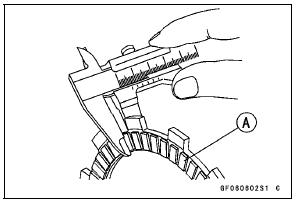
Friction Plate Thickness
Standard: 2.72  2.88 mm
(0.107  0.113 in.)
Service Limit: 2.5 mm (0.098 in.)
 Spring Plate Free Play Adjustment
 Clutch Plate Warp Inspection
Connecting Rod Installation
NOTICE
To minimize vibration, the connecting rods should
have the same weight mark.
Big End Cap [A]
Connecting Rod [B]
Weight Mark, Alphabet [C]
Diameter Mark [D] (“� or No Mark)
NOTICE
If the connecting rods, big end bearing inserts, or
crankshaft are replaced with new ones, select ...
Antenna Resistance Inspection
Turn the ignition switch to OFF.
Remove the air cleaner housing (see Air Cleaner Housing
Removal in the Fuel System (DFI) chapter).
Disconnect the antenna lead connector [A].
Measure the antenna resistance.
Antenna Resistance
Connections: BK lead ←→ BK/W lead
Standard: Ab ...
Exhaust Butterfly Valve Actuator Inspection
NOTE
Be sure the battery is fully charged
Remove the front seat (see Front Seat Removal in the
Frame chapter).
Turn the ignition switch to ON.
In the left side view of the motorcycle, check to see
the pulley [A] clockwise [B] and counterclockwise [C]
smoothly.
The pulley turns ...