
If this service code appears, check that the following parts are correctly.
Crankshaft Sensor Gear Position Switch Starter Lockout Switch Main Throttle Sensor Rear Wheel Rotation Sensor
If these parts are normal, check the ESD ECU for its ground and power supply (see ESD ECU Power Supply Inspection).
ESD ECU Removal
ESD ECU Installation
Refer to the ESD (Electronic Steering Damper) ECU Installation in the Steering chapter.
ESD ECU Power Supply Inspection
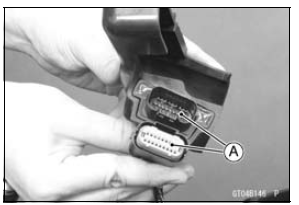
If the connector is clogged with mud or dust, blow it off with compressed air.
If the terminals of the main harness connector are damaged, replace the main harness.
If the terminals of the ESD ECU connectors are damaged, replace the ESD ECU.
Special Tool - Hand Tester: 57001-1394
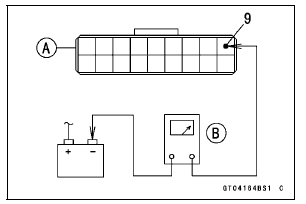
ESD ECU Grounding Inspection Connections: (I) BK/Y lead (ESD ECU terminal 9) ←→ Battery (–) Terminal (II) Engine Ground ←→ Battery (–) Terminal Criteria: Both: 0 Ω
If no continuity, check the connector, the engine ground lead, or main harness, and repair or replace them if necessary.
If the wiring is good, check the power source voltage of the ESD ECU.
NOTE
Be sure the battery is fully charged.
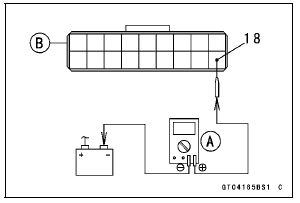
Special Tool - Needle Adapter Set: 57001-1457
ESD ECU Power Supply Inspection Connections:
(I) Digital Meter (+) → Terminal 18 (BR/BK) Digital Meter (–) → Battery (–) terminal
Ignition Switch OFF: 0 V
Ignition Switch ON: Battery Voltage
If the reading is out of the specification, check the following.
Main Fuse 30 A (see Fuse Inspection in the Electrical System chapter) Electronic Steering Damper Fuse 10 A (see Fuse Inspection in the Electrical System chapter) Power Source Wiring (see wiring diagram in this section)
If the fuse and wiring are good, replace the ESD ECU (see ESD (Electronic Steering Damper) ECU Removal/Installation in the Steering chapter).
ESD ECU Power Source Circuit
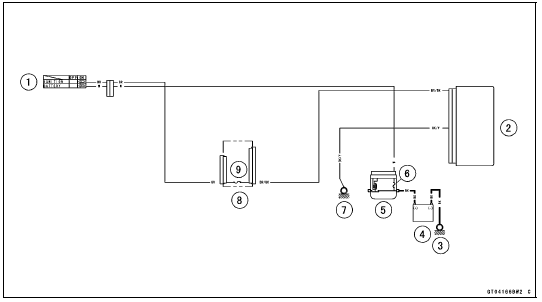
1. Ignition Switch
2. ESD ECU
3. Engine Ground
4. Battery
5. Starter Relay
6. Main Fuse 30 A
7. Frame Ground 3
8. Fuse Box 1
9. ESD Fuse 10 A
 ESD Actuator Input Voltage Inspection
Tire Repair
Currently two types of repair for tubeless tires have come
into wide use. One type is called a temporary (external) repair
which can be carried out without removing the tire from
the rim, and the other type is called permanent (internal)
repair which requires tire removal. It is generally unders ...
Engine Vacuum Synchronization Inspection
NOTE
These procedures are explained on the assumption that
the intake and exhaust systems of the engine are in
good condition.
Situate the motorcycle so that it is vertical.
Remove:
Fuel Tank (see Fuel Tank Removal in the Fuel System
(DFI) chapter)
Air Cleaner Housing (see Air Cleaner ...
Hub Bearing Inspection
Since the hub bearings are made to extremely close tolerances,
the clearance can not normally be measured.
NOTE
Do not remove any bearings for inspection. If any bearings
are removed, they will need to be replaced with
new ones.
Turn each bearing in the hub back and forth [A] while
checki ...
