
NOTE
Be sure the battery is fully charged.
Main Harness [B] Fuel Pump [C]
Special Tool - Measuring Adapter: 57001-1700
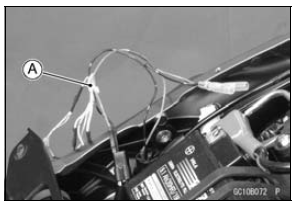
Fuel Pump Operating Voltage Connections to Adapter:
Digital Meter (+) → R (pump Y/R) lead
Digital Meter (–) → BK (pump BK/W) lead
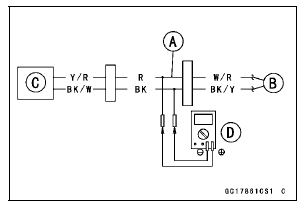
Operating Voltage Standard: Battery Voltage for 3 seconds, and then 0 V
If the reading stays on battery voltage and never shows 0 V, check the fuel pump relay (see Relay Circuit Inspection in the Electrical System chapter).
If the fuel pump relay is normal, check the ECU for its ground and power supply (see ECU Power Supply Inspection).
If the ground and power supply are good, replace the ECU (see ECU Removal/Installation).
If there is still no battery voltage, check the fuel pump relay (see Relay Circuit Inspection in the Electrical System chapter).
If the fuel pump relay is normal, check the wiring for continuity (see wiring diagram in this section).
Special Tool - Hand Tester: 57001-1394
If the wiring is good, check the ECU for its ground and power supply (see ECU Power Supply Inspection).
If the ground and power supply are good, replace the ECU (see ECU Removal/Installation).
If the reading is in specification, but the pump does not operate, replace the fuel pump (see Fuel Pump Removal/Installation).
 Fuel Pump Operation Inspection
 Pressure Regulator Removal
Storage
Preparation for Storage
Clean the entire vehicle thoroughly
Run the engine for about five minutes to warm the oil, shut it off, and
drain the
engine oil.
WARNINGEngine oil is a toxic substance. Dispose
of used oil properly. Contact
your local authorities for approved disp ...
Average Mileage
This display mode shows the average
mileage by numerical value
counted from the start of measuring to
present time.
A. Average Mileage
B. “AV km/L�
While the average mileage is displayed,
push the lower button and
hold it in until the average mileage
values resets to “– †...
Shift Drum Assembly
Press and insert the ball bearing [A] on the shift drum [B]
until it is bottomed.
Install:
Ball Bearing [C]
Dowel Pin [D] and Shift Drum Cam [E]
Align the pin with the groove in the shift drum cam.
Apply a non-permanent locking agent to the shift drum
cam holder bolt [F].
Tight ...