
NOTICE
Do not turn the compression damping force adjuster beyond the fully seated position or the adjusting mechanism may be damaged.
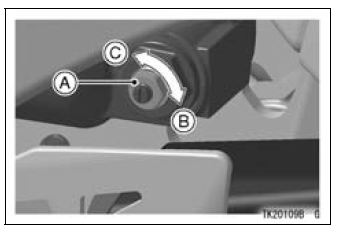
A. Compression Damping Force Adjuster for High Speed
B. To increase damping force
C. To decrease damping force
Compression Damping Force Setting for High and Low Speeds
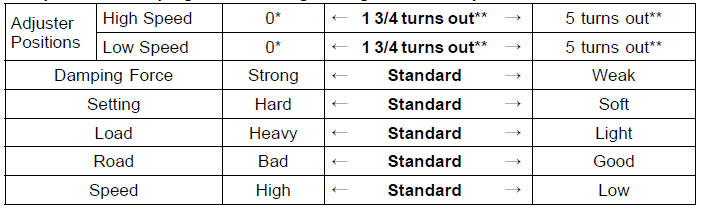
*: This position is the fully seated position (turned fully clockwise).
**: Out from the fully seated position (turned fully clockwise). This adjustment range may not exactly match the number shown in the table due to small tolerance of production.
The standard suspension setting positions are as follows:
Standard Setting Position (Rear Shock Absorber)

*: Out from the fully seated position (turned fully clockwise)
 Compression Damping Force Adjustment
 Wheels
Washing Your Motorcycle
Rinse your bike with cold water from
a garden hose to remove any loose
dirt.
Mix a mild neutral detergent (designed
for motorcycles or automobiles)
and water in a bucket. Use
a soft cloth or sponge to wash your
motorcycle. If needed, use a mild degreaser
to remove any oil or greas ...
Lap Counter/Coolant/Intake Air Temperature Meter
This meter shows the coolant temperature,
the intake air temperature or
the lap number. The lap number is displayed
in the stop watch mode, refer to
the “Stop Watch� item in this section.
A. Lap Counter/Coolant / Intake Air
Temperature Meter
The coolant temperature meter and
inta ...
Sidestand Removal
Raise the rear wheel off the ground with the stand [A].
Remove:
Sidestand Switch Bolt [A]
Sidestand Switch [B]
Remove:
Spring [A]
Sidestand Nut [B]
Sidestand Bolt [C]
Sidestand [D]
...