
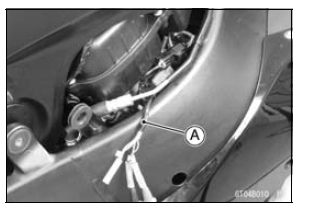
Disconnect the main throttle sensor connector and connect the setting adapter [A] between these connectors.
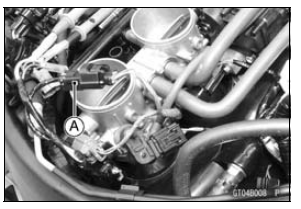
Special Tool - Throttle Sensor Setting Adapter: 57001 -1538
Main Throttle Sensor Output Voltage Connections to Adapter: Digital Meter (+) → R (sensor V/W) lead
Digital Meter (–) → BK (sensor BR/BK) lead
Install the following parts temporarily.
Throttle Body Assy (see Throttle Body Assy Installation in the Fuel System (DFI) chapter) Air Cleaner Housing (see Air Cleaner Housing Installation in the Fuel System (DFI) chapter) Fuel Tank (see Fuel Tank Installation in the Fuel System (DFI) chapter)
Throttle Sensor Setting Adapter [A]
Idle Speed Standard: 1 100 ±50 r/min (rpm)
Output Voltage
Standard: DC 0.64 0.68 V at idle
throttle opening
DC 3.89  4.09 V at full throttle
opening (for
reference)
NOTE
Example: In the case of a input voltage of 4.75 V.
0.64 × 4.75 ÷ 5.00 = 0.61 V
0.68 × 4.75 ÷ 5.00 = 0.65 V
Thus, the valid range is 0.61
0.65 V
If the reading is out of the standard, replace the throttle body assy.
If the reading is within the standard, remove the ECU and check the wiring for continuity between harness connectors.
Special Tool - Hand Tester: 57001-1394
Disconnect the ECU and sensor connectors.
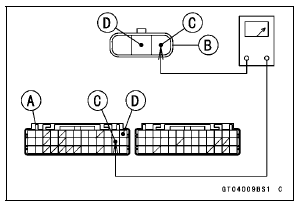
Wiring Continuity Inspection ECU Connector [A] ←→ Main Throttle Sensor Connector [B] V/W lead (ECU terminal 25) [C] BR/BK lead (ECU terminal 13) [D]
If the wiring is good, check the ECU for its ground and power supply (see ECU Power Supply Inspection in the Fuel System (DFI) chapter).
If the ground and power supply are good, replace the ECU (see ECU Removal/Installation in the Fuel System (DFI) chapter).
Main Throttle Sensor Circuit
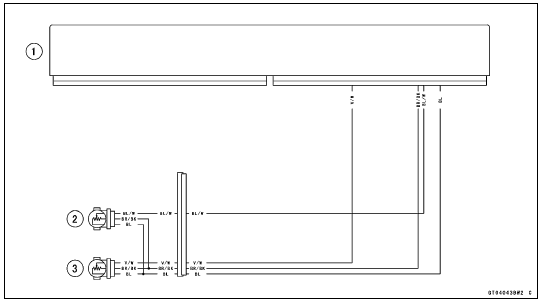
1. ECU
2. Subthrottle Sensor
3. Main Throttle Sensor
 Main Throttle Sensor Resistance Inspection
Camshaft Removal
Remove:
Cylinder Head Cover (see Cylinder Head Cover Removal)
Crankshaft Sensor Cover (see Crankshaft Sensor Removal
in the Electrical System chapter)
Using a wrench on the timing rotor bolt [A], turn the crankshaft
clockwise until the line [B] (TDC mark for #1,4 pistons)
on the timin ...
Brake Pad Wear Inspection
Remove the brake pads (see Front/Rear Brake Pad Removal
in the Brakes chapter).
Check the lining thickness [A] of the pads in each caliper.
If the lining thickness of either pad is less than the service
limit [B], replace both pads in the caliper as a set.
Front Brake Pad [C]
Rea ...
Check 3-6: Neutral Indicator Light (LED) Inspection
Connect the leads in the same circuit as Check 3-2.
Connect the terminal [8] to the battery (–) terminal.
Check that the neutral indicator light (LED) [A] goes on.
If the indicator light does not go on, replace the meter unit.
...
