
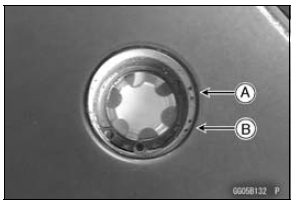
Check that the engine oil level is between the upper [A] and lower [B] levels in the gauge.
NOTE
NOTICE
Racing the engine before the oil reaches every part can cause engine seizure.
If the engine oil gets extremely low or if the oil pump or oil passages clog up or otherwise do not function properly, the warning indicator light (LED) and oil pressure warning symbol will light. If this light stays on when the engine is running above idle speed, stop the engine immediately and find the cause.
If the oil level is too high, remove the excess oil, using a syringe or some other suitable device.
If the oil level is too low, add the correct amount of oil through the oil filler opening. Use the same type and make of oil that is already in the engine.
NOTE
If the engine oil type and make are unknown, use any brand of the specified oil to top off the level in preference to running the engine with the oil level low. Then at your earliest convenience, change the oil completely.
 Engine Oil and Oil Filter
 Engine Oil Change
Rocker Arm Installation
Install the both rocker arms [A] so that their marks [B] face
left side.
Replace the tie-rod nut, rear shock absorber nut and
rocker arm nut with new ones.
Apply grease to the inside of the oil seals.
Tighten:
Torque - Rocker Arm Nut: 34 N·m (3.5 kgf·m, 25 ft·lb)
Tie-Rod ...
Specifications
Connecting Rod Big End Bearing Insert Selection
Crankshaft Main Bearing Insert Selection
*: The bearing inserts for Nos. 2 and 4 journals have an oil groove,
respectively. ...
Damping Force Adjustment (
ZX1000JC/KC)
To adjust the damping force, turn the damping adjuster
[A] until you feel a click.
The standard adjuster setting is the 18th click from the
1st of the fully clockwise position. If the damping feels too
soft or too stiff, adjust it in accordance with the following
table.
Damping Force Adj ...