
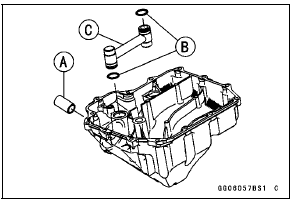
If the oil filter holder bolt [A] was removed, tighten it.
Apply a non-permanent locking agent to the threads of the oil filter holder bolt.
Torque - Oil Filter Holder Bolt: 35 N·m (3.6 kgf·m, 26 ft·lb)
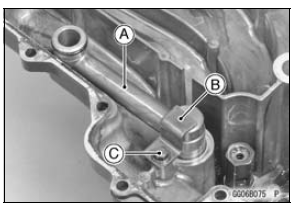
Blow away the particles by applying compressed air [B] from the inside to the outside (from the clean side to the dirty side).
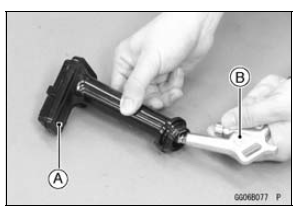
| WARNING Gasoline and low flash-point solvents can be flammable and/or explosive and cause severe burns. Clean the screen in a well-ventilated area, and take care that there are no sparks or flame anywhere near the working area; this includes any appliance with a pilot light. Do not use gasoline or a low flash-point solvent to clean the screen. |
NOTE
While cleaning the oil screen, check for any metal particles that might indicate internal engine damage.
If the screen is damaged, replace it.
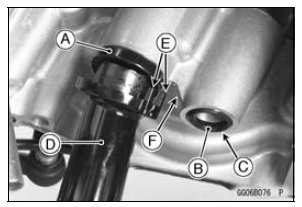
Face the flanged side [B] to the bottom.
Lower Crankcase [C]
Face the knob of the clamp [F] inward as shown in the figure.
Viewed from Bottom [G]
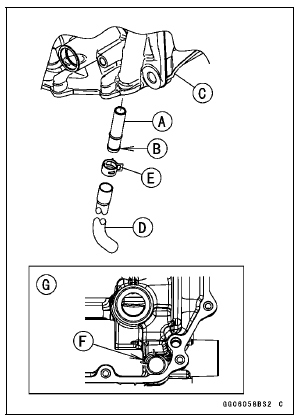
Turn the chamfered side [C] downward.
Fit the claws [E] to the crankcase rib [F].
Torque - Oil Pan Bolts: 9.8 N·m (1.0 kgf·m, 87 in·lb)
Front [D]
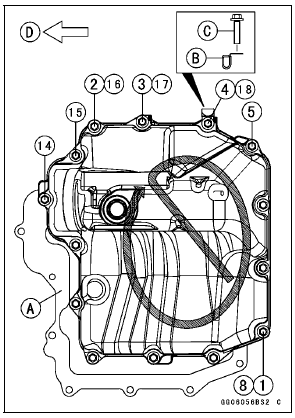
 Oil Pan Removal
Exhaust System Identification
Exhaust Pipe Mark Position [A]
Premuffler Chamber Mark Position [A]
Muffler Body Mark Position [A]
Premuffler Chamber [A] with Hole [B] for Oxygen Sensor [C]
Honeycomb Type Catalyst Position [A]
Specifications
...
Engine Sprocket Removal
Remove:
Engine Sprocket Cover Bolts [A]
Engine Sprocket Cover [B]
Flatten out the bended washer [A].
Remove the engine sprocket nut [B] and washer.
NOTE
When loosening the engine sprocket nut, hold the rear
brake on.
Raise the rear wheel off the ground with the stand. ...
Terminal Numbers of ECU Connectors
1. Subthrottle Valve Actuator: Y/BK
2. Subthrottle Valve Actuator: BK/O
3. Unused
4. Front Wheel Rotation Sensor Signal: G/Y
5. Unused
6. Starter Lockout Switch: R/G
7. Gear Position Switch: G/R
8. Crankshaft Sensor (–): BK
9. Power Supply to Sensors: BL
10. Unused
11. Intake Air Pre ...
