
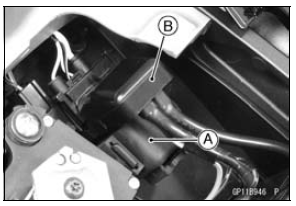
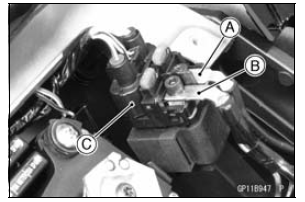
Special Tool - Hand Tester: 57001-1394
Replace the relay.
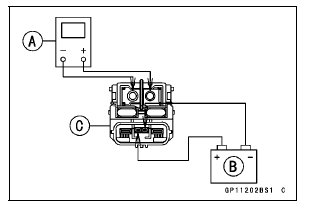
Testing Relay Tester Range: × 1 Ω range
When battery is connected → 0 Ω When battery is disconnected → ∞ Ω
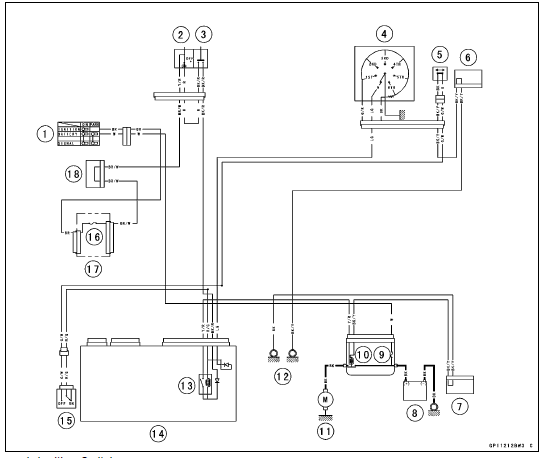
1. Ignition Switch
2. Engine Stop Switch
3. Starter Button
4. Gear Position Switch
5. Sidestand Switch
6. Joint Connector E
7. Joint Connector B
8. Battery
9. Main Fuse 30 A
10. Starter Relay
11. Starter Motor
12. Frame Grounds
13. Starter Circuit Relay
14. Relay Box
15. Starter Lockout Switch
16. Ignition Fuse 15 A
17. Fuse Box 1
18. Joint Connector F
 Right-hand End Cover Inspection
 Lighting System
Subthrottle Sensor Resistance Inspection
Turn the ignition switch to OFF.
Disconnect the subthrottle sensor connector.
Connect a digital meter [A] to the subthrottle sensor connector
[B].
Measure the subthrottle sensor resistance.
Subthrottle Sensor Resistance
Connections: BL lead [D] ←→ BR/BK lead [C]
Standard: ...
Rear Caliper Removal
Remove:
Bolt [A]
Rear Wheel Rotation Sensor [B]
Loosen the banjo bolt [C] at the brake hose lower end,
and tighten it loosely.
Loosen the caliper holder pin [D].
Remove the rear wheel (see Rear Wheel Removal in the
Wheels/Tires chapter).
Unscrew the banjo bolt and remove t ...
Liquid Gasket, Non-permanent Locking Agent
For applications that require Liquid Gasket or a
Non-permanent Locking Agent, clean the surfaces so
that no oil residue remains before applying liquid gasket or
non-permanent locking agent. Do not apply them excessively.
Excessive application can clog oil passages and
cause serious damage.
...