
NOTICE
Do not remove the bearings for inspection. Removal may damage them.
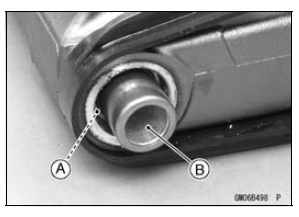
The rollers and ball in a bearing normally wear very little, and wear is difficult to measure. Instead of measuring, visually inspect the bearing for abrasion, discoloration, or other damage.
If the needle bearing, and sleeve [B] show any sings of abnormal wear, discoloration, or damage, replace them as a set.
If bearing play, roughness, or binding is found, replace the bearing.
If the seal is torn or is leaking, replace the bearing.
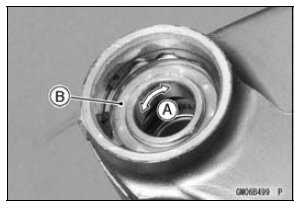
Swingarm Bearing Lubrication
NOTE
Since the bearing are packed with grease and sealed, lubrication is not required.
 Swingarm Bearing Installation
Cable, Wire, and Hose Routing
1. Clamp (Hold the regulator/rectifier lead. Run the lead inside of the
installation hole.)
2. Clamp (Bend down the clamp, and hold the main harness and the vacuum hose
(equipped
models).)
3. Clamp (Hold the air intake solenoid valve lead (equipped models).)
4. Run the vacuum hose under ...
For Primary Fuel Injectors
Remove the air cleaner housing (see Air Cleaner Housing
Removal).
Disconnect the primary fuel injector connector [A].
Connect a digital meter to the terminals in each primary
fuel injector [A].
Measure the primary fuel injector resistance.
Primary Fuel Injector Resistance ...
Coolant Temperature Meter
The coolant temperature gauge indicates
temperature of the engine
coolant. The “ � symbol is displayed
if the coolant temperature meter
is selected.
A. Coolant Temperature Meter
B. Warning Indicator Light (Red)
C. “ � Symbol
If the coolant temperature is below
40°C (104°F ...
