
NOTE
Be sure the battery is fully charged.
Main Harness [B] Vehicle-down Sensor [C]
Special Tool - Measuring Adapter: 57001-1700
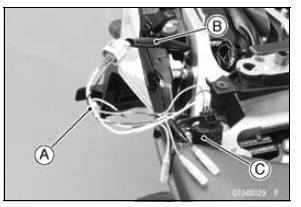
Vehicle-down Sensor Input Voltage Connections to Adapter: Digital Meter (+) → R (sensor BL) lead Digital Meter (–) → BK (sensor BR/BK) lead
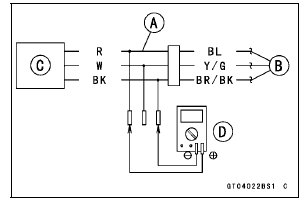
Input Voltage
Standard: DC 4.75  5.25 V
If the reading is within the standard, check the output voltage (see Vehicle-down Sensor Output Voltage Inspection).
If the reading is out of the standard, remove the ECU and check the wiring for continuity between main harness connectors.
Special Tool - Hand Tester: 57001-1394
Disconnect the ECU and sensor connectors.
Wiring Continuity Inspection ECU Connector [A] ←→ Vehicle-down Sensor Connector [B] BL lead (ECU terminal 9) [C] BR/BK lead (ECU terminal 13) [D]
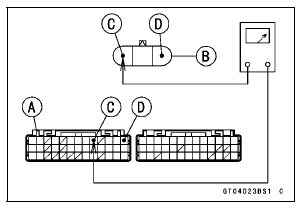
If the wiring is good, check the ECU for its ground and power supply (see ECU Power Supply Inspection in the Fuel System (DFI) chapter).
If the ground and power supply are good, replace the ECU (see ECU Removal/Installation in the Fuel System (DFI) chapter).
 Vehicle-down Sensor Installation
 Vehicle-down Sensor Output Voltage Inspection
Air Switching Valve
Air Switching Valve Operation Test
Refer to the Air Suction System Damage Inspection in the
Periodic Maintenance chapter.
Air Switching Valve Unit Test
Remove the air switching valve (see Air Switching Valve
Removal in the Engine Top End chapter).
Set the hand tester [A] to the × 1 ...
Spring Preload Adjustment
The spring preload adjuster is located
at the lower end of each front fork leg
and can be adjusted.
To increase spring preload and
stiffen the suspension, turn the
preload adjuster clockwise with a
hexagon wrench.
To decrease preload and soften the
suspension, turn the preload adjust ...
Related Parts Locations
KIBS Control
1. ABS performance equivalent to the current model (enhanced braking
stability)
By monitoring front caliper hydraulic pressure, KIBS regulates pressure
increases reducing the tendency
of the rear to lift. Before the ABS system fully reacts, KIBS system prevents
the pressure ...