
NOTE
Use the battery which is fully charged.
Special Tools - Compression Gauge, 20 kgf/cm²: 57001-221 Compression Gauge Adapter, M10 × 1.0: 57001-1601 L-Shape Hose [C]: 57001-1606
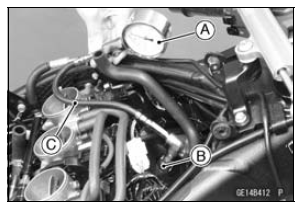
Cylinder Compression
Usable Range: 1 099  1 668 kPa (11.2
 17.0 kgf/cm²,
159  242 psi) at 320 r/min (rpm)
The following table should be consulted if the obtainable compression reading is not within the usable range.
| Problem | Diagnosis | Remedy (Action) |
| Cylinder compression is higher than usable range | Carbon accumulation on piston and in combustion chamber possibly due to damaged valve stem oil seal and/or damaged piston oil rings (This may be indicated by white exhaust smoke). | Remove the carbon deposits and replace damaged parts if necessary. |
| Incorrect cylinder head gasket thickness | Replace the gasket with a standard part. | |
| Cylinder compression is lower than usable range | Gas leakage around cylinder head | Replace damaged gasket and check cylinder head warp |
| Bad condition of valve seating | Repair if necessary. | |
| Incorrect valve clearance | Adjust the valve clearance. | |
| Incorrect piston/cylinder clearance | Replace the piston and/or cylinder. | |
| Piston seizure | Inspect the cylinder and replace/repair the cylinder and/or piston as necessary. | |
| Bad condition of piston ring and/or piston ring grooves | Replace the piston and/or the piston rings. |
 Cylinder Head
 Cylinder Head Removal
Subthrottle Valve Actuator Inspection
NOTE
Be sure the battery is fully charged.
Remove the air cleaner housing (see Air Cleaner Housing
Removal in the Fuel System (DFI) chapter).
Turn the ignition switch to ON.
Check to see that all the subthrottle valves [A] open and
close smoothly.
Turn the ignition switch to OFF.
I ...
Master Cylinder Inspection (Visual Inspection)
Remove the master cylinders (see Front/Rear Master
Cylinder Removal).
Disassemble the front and rear master cylinders (see
Master Cylinder Rubber Parts Replacement in the Periodic
Maintenance chapter).
Check that there are no scratches, rust or pitting on the
inner wall [A] of each ma ...
Multifunction Display
The multifunction display indicates
the following modes.
Odometer
Trip meter A
Trip meter B
Current Mileage
Average Mileage
Fuel Consumption
Stop Watch
These display modes can be shifted
by pushing the upper button.
NOTE
The “FUEL� warning can be indicated
if the ...