
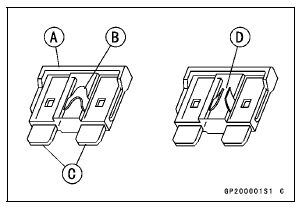
If it is blown out, replace the fuse. Before replacing a blown fuse, always check the amperage in the affected circuit. If the amperage is equal to or greater than the fuse rating, check the wiring and related components for a short circuit.
Housing [A] Fuse Element [B] Terminals [C] Blown Element [D]
NOTICE
When replacing a fuse, be sure the new fuse matches the specified fuse rating for that circuit.
Installation of a fuse with a higher rating may cause damage to wiring and components.
 Fuse Box Fuse Removal
 Self-Diagnosis System
Air Switching Valve Removal
NOTICE
Never drop the air switching valve especially on a
hard surface. Such a shock to the air switching
valve can damaged it.
Remove the air cleaner housing (see Air Cleaner Housing
Removal in the Fuel System (DFI) chapter).
Disconnect the connector [A].
Disconnect the hoses [B] from ...
Intake Air Pressure Sensor #1 Input Voltage Inspection
NOTE
Be sure the battery is fully charged.
Turn the ignition switch to OFF.
Remove the air cleaner housing (see Air Cleaner Housing
Removal in the Fuel System (DFI) chapter).
Disconnect the intake air pressure sensor #1 connector
and connect the measuring adapter [A] between these
con ...
Ignition Switch Replacement
Remove:
Air Cleaner Housing (see Air Cleaner Housing Removal
in the Fuel System (DFI) chapter)
Disconnect the lead connectors [A].
Remove:
Steering Stem Head (see Stem, Stem Bearing Removal
in the Steering chapter)
Using a small chisel or punch [A], turn out the Torx bolts.
...