
Special Tool - Hand Tester: 57001-1394
Crankshaft Sensor Resistance
Connections:
Meter (+) → Y lead
Meter (–) → BK lead
Standard: 376  564 Ω
564 Ω
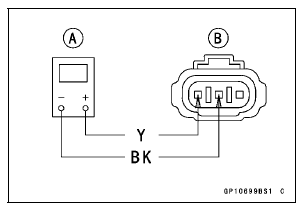
If there is more resistance than the specified value, the coil has an open lead and must be replaced. Much less than this resistance means the coil is shorted, and must be replaced.
Any tester reading less than infinity (∞) indicates a short, necessitating replacement of the crankshaft sensor.
 Crankshaft Sensor Installation
 Crankshaft Sensor Peak Voltage Inspection
Crankshaft Main Bearing
Insert/Journal Wear Inspection
Split the crankcase (see Crankcase Splitting).
Cut strips of plastigage to journal width.
Place a strip on each journal parallel to the crankshaft
installed in the correct position.
Tighten the crankcase bolts to the specified torque (see
Crankcase Assembly).
NOTE
Do not turn ...
Periodic Maintenance Chart
The scheduled maintenance must be done in accordance with this chart to keep
the motorcycle in
good running condition. The initial maintenance is vitally important and must
not be neglected.
Periodic Inspection
#: Service more frequently when operating in severe conditions; dusty, ...
Handlebar Removal
Remove:
Steering Damper (see Steering Damper Removal)
Clutch Lever Clamp Bolts [A]
Clutch Lever Assembly [B]
Left Switch Housing [C]
Handlebar Weight [D]
Left Handlebar Grip [E]
Remove:
Front Master Cylinder [A] (see Front Master Cylinder Removal
in the Brakes chapter)
...