
Insufficient clutch free play will cause the engine braking effect to be more sudden, resulting in rear wheel hop. On the other hand, if the free play is excessive, the clutch lever may feel “spongy� or pulsate when pulled.
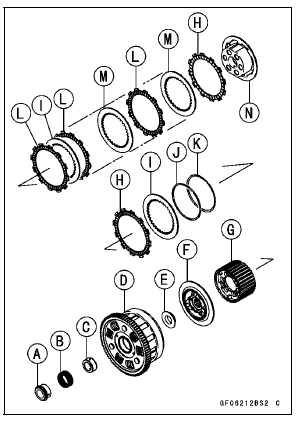
Collar [A]
Needle Bearing [B]
Sleeve [C]
Clutch Housing [D]
Spacer [E]
Clutch Hub [F]
Sub Clutch Hub [G]
Friction Plates (48 Lining Blocks) [H] (#1, #10)
Steel Plates (T = 2.9) [I] (#1 
#7)
Spring Seat [J]
Spring [K]
Friction Plates (36 Lining Blocks) [L] (#2
 #9)
#9)
Steel Plates (T = 2.6) [M] (#8, #9)
Clutch Spring Plate [N]
Drive Shaft [D]
Spring Plate Free Play
Usable Range: 0.05  0.70 mm (0.002
 0.028 in.)
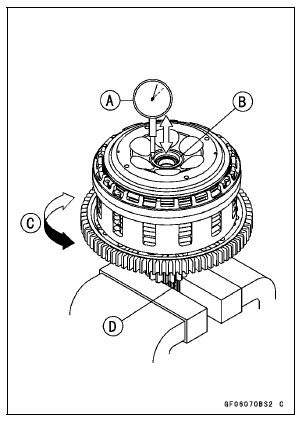
If the free play is not within the usable range, change all of the friction plate and measure the free play again.
If the free play is not within the usable range, adjust the free play (see Spring Plate Free Play Adjustment).
 Clutch Installation
 Spring Plate Free Play Adjustment
Stick Coil Removal
Remove the air cleaner housing (see Air Cleaner Housing
Removal in the Fuel System (DFI) chapter).
Disconnect the stick coil connectors [A].
Pull out the stick coils [B] upward.
First, turn the stick coil by 90 degrees, and then pull it out
by twisting the coil head to the left and righ ...
Transmission Shaft Disassembly
Remove the transmission shafts (see Transmission Shaft
Removal).
Remove the circlips, and then disassemble the transmission
shafts.
Special Tool - Outside Circlip Pliers: 57001-144
The 5th gear [A] on the output shaft has three steel balls
assembled into it for the positive neutral fin ...
Vehicle-down Sensor Installation
Be sure to install the rubber dampers [A] and collars [B]
on the bracket.
The UP mark [A] of the sensor should face upward.
WARNINGIncorrect installation of the vehicle-down
sensor
could cause sudden loss of engine power. The
rider could lose balance during certain ...