
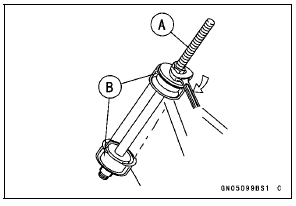
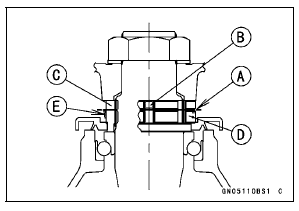
Special Tools - Head Pipe Outer Race Press Shaft [A]: 57001-1075
Head Pipe Outer Race Driver, 
55 [B]: 57001
-1446 or Bearing Driver Set: 57001-1129
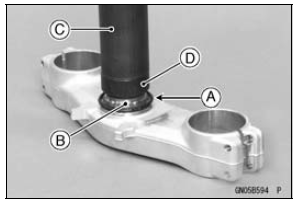
Special Tools - Steering Stem Bearing Driver,
 42.5 [C]:
57001-1344
Steering Stem Bearing Driver Adapter,

41.5 [D]: 57001-1345
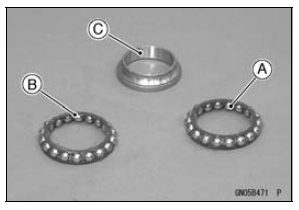
The lower and upper ball bearings are identical.
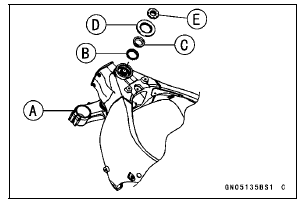
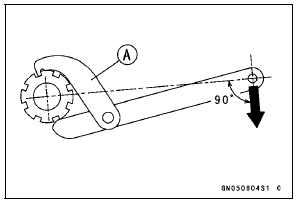
Tighten the steering stem nut with 55 N·m (5.6 kgf·m, 41 ft·lb) of torque first, and loosen it a fraction of a turn until it turns lightly. Afterward tighten it again with specified torque using a steering stem nut wrench [A].
Check that there is no play and the steering stem turns smoothly without rattles. If not, the steering stem bearings may be damaged.
Special Tool - Steering Stem Nut Wrench: 57001-1100
Torque - Steering Stem Nut: 20 N·m (2.0 kgf·m, 15 ft·lb)
NOTE
Torque - Front Fork Clamp Bolts (Upper): 20 N·m (2.0 kgf·m, 15 ft·lb) Steering Stem Head Nut: 78 N·m (8.0 kgf·m, 58 ft·lb) Front Fork Clamp Bolts (Lower): 23 N·m (2.3 kgf·m, 17 ft·lb) Handlebar Clamp Bolts: 25 N·m (2.5 kgf·m, 18 ft·lb)
| WARNING If the handlebar does not turn to the steering stop it may cause an accident resulting in injury or death. Be sure the cables, harnesses and hoses are routed properly and do not interfere with handlebar movement (see Cable, Wire, and Hose Routing section in the Appendix chapter). |
Steering Stem Bearing Lubrication
 Stem, Stem Bearing Removal
 Steering Stem Warp Inspection
Engine Removal
Support the rear part of the swingarm with a stand.
Squeeze the brake lever slowly and hold it with a band
[A].
WARNINGMotorcycle may fall over unexpectedly
resulting in
an accident or injury. Be sure to hold the front brake
when removing the engine.
NOTICE
Be sure ...
Rear Frame Front Removal
Remove:
Rear Frame Rear (see Rear Frame Rear Removal)
Rear Fender Front (see Rear Fender Front Removal)
Rear Footpeg Bracket Bolts [A]
Rear Footpeg Bracket [B]
Rear Frame Front Bolts [C]
Left Rear Frame Front [D]
Remove:
Rear Footpeg Bracket Bolts [A]
Rear Footpeg Bracke ...
Stick Coil Primary Peak Voltage Inspection
NOTE
Be sure the battery is fully charged.
Remove the stick coils (see Stick Coil Removal).
Do not remove the spark plugs.
Connect the ECU to the harness.
Measure the primary peak voltage as follows.
Install the new spark plug [A] into each stick coil [B], and
ground them onto ...