
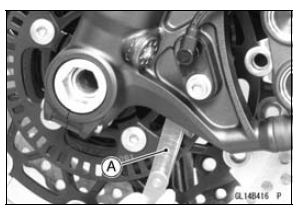
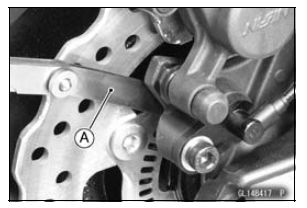
Thickness Gauge [A]
Wheel Rotation Sensor Air Gap Standard:
Front 0.4  1.6 mm (0.02
 0.06 in.)
Rear 0.4  1.6 mm (0.02
 0.06 in.)
NOTE
The sensor air gap cannot be adjusted.
If the air gap is not within the specification, inspect the hub bearing (see Hub Bearing Inspection in the Wheels/Tires chapter), sensor installation condition and sensor (see Wheel Rotation Sensor Inspection).
 Wheel Rotation Sensor Inspection
 Wheel Rotation Sensor Rotor Inspection
Self-Diagnosis Outline
The self-diagnosis system is monitoring the following
mechanisms.
DFI System and Ignition System
S-KTRC System
Immobilizer System (Equipped Models)
KIBS and ABS (Equipped Models)
ESD (Electronic Steering Damper) System
(ZX1000JD/KD)
The following warning indicator lights (LED) are used for ...
Ignition Switch/Steering Lock
This is a three-position, key-operated
switch. The key can be removed from
the switch when it is in the OFF or
LOCK position.
A. Ignition Switch/Steering Lock
B. ON position
C. OFF position
D. LOCK position
NOTE
The tail, city and license plate lights
are on whenever the ignition key i ...
Parking
WARNINGOperating or parking the vehicle
near flammable materials can
cause a fire, and can result in
property damage or severe personal
injury.
Do not idle or park your vehicle
in an area where tall or dry vegetation,
or other flammable materials
could come into cont ...