
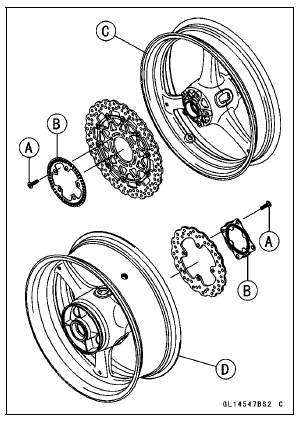
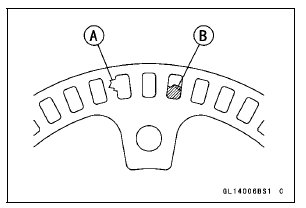
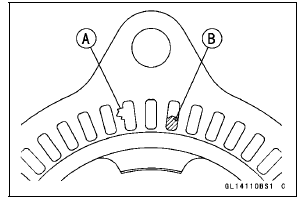
If the rotor is deformed or damaged (chipped teeth [A]), replace the sensor rotor with a new one.
If there is iron or other magnetic deposits [B], remove the deposits.
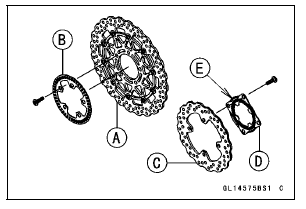
When installing the rear wheel rotation sensor rotor, the bended end [E] faces to disc side.
Install the brake discs (see Brake Disc Installation).
KIBS Solenoid Valve Relay Fuse (20 A) Removal
Refer to the Fuse Box Fuse Removal in the Electrical System chapter.
KIBS Motor Relay Fuse (30 A) Removal
Refer to the Fuse Box Fuse Removal in the Electrical System chapter.
Fuse Installation
If a fuse fails during operation, inspect the electrical system to determine the cause, and then replace it with a new fuse of proper amperage (see Fuse Installation in the Electrical System chapter).
Fuse Inspection
 Wheel Rotation Sensor Air Gap Inspection
 Suspension
Throttle Control System Inspection
Check the throttle grip free play [A].
If the free play is incorrect, adjust the throttle cables.
Throttle Grip Free Play
Standard: 2 3 mm (0.08
0.12 in.)
Check that the throttle grip [B] moves smoothly from full
open to close, and the throttle closes quickly and completely
by the ...
Exhaust Butterfly Valve Actuator Resistance Inspection
Turn the ignition switch to OFF.
Disconnect the exhaust butterfly valve actuator lead connector
(2 pins connector) [A].
Set the hand tester to the × 1 Ω range and connect it to
the exhaust butterfly valve actuator connector.
Special Tool - Hand Tester: 57001-1394
Measure ...
ECU Removal
NOTICE
Never drop the ECU especially on a hard surface.
Such a shock to the ECU can damage it.
Remove the upper air cleaner housing (see Air Cleaner
Element Replacement in the Periodic Maintenance chapter).
Lift up the ECU [A] with rubber protector [B] to disconnect
the connectors [C]. ...