
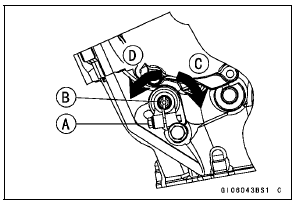
The amount of backlash can be changed by turning the balancer shaft which has eccentric journals.
Start the engine and let it idle.
Loosen the clamp bolt [A] and turn the balancer shaft [B] clockwise [C] until the balancer gear makes a whining sound.
Turn the shaft counterclockwise [D] until the balancer gear whining sound disappears and tighten the clamp bolt.
Torque - Balancer Shaft Clamp Bolt: 9.8 N·m (1.0 kgf·m, 87 in·lb)
 Balancer Installation
 Balancer Damper Inspection
Exploded View
5. Other than US, CA, and CAL Models
6. The big diameter side of the dampers faces upward.
G: Apply grease.
L: Apply a non-permanent locking agent.
R: Replacement Parts
S: Follow the specified tightening sequence.
SS: Apply silicone sealant.
11. Immobilizer Ampli ...
Air Cleaner
A clogged air cleaner restricts the engine’s
air intake, increasing fuel consumption,
reducing engine power, and
causing spark plug fouling.
This motorcycle’s air cleaner element
consists of a wet paper filter, which cannot
be cleaned.
The air cleaner element must be replaced
in acco ...
Rear Turn Signal Light Bulb Replacement
Remove the upper seat cover (see Seat Cover Removal
in the Frame chapter).
Disconnect the tail/brake light connector [A].
Turn the socket [A] counterclockwise and remove the
socket together with the bulb.
Push and turn the turn signal light bulb [A] counterclockwise
an ...