
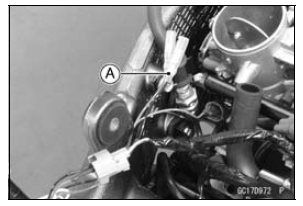
Main Harness [B] Primary Fuel Injector #1 [C]
Special Tool - Measuring Adapter: 57001-1700
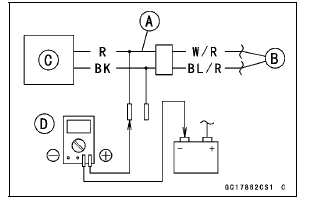
Primary Fuel Injector Power Source Voltage Connections to Adapter:
For Primary Fuel Injector #1, #2, #3, #4
Digital Meter (+) → R (injector W/R) lead
Digital Meter (–) → Battery (–) terminal
Power Source Voltage Standard: Battery Voltage for 3 seconds, and then 0 V
If the reading stays on battery voltage and never shows 0 V, check the fuel pump relay (see Relay Circuit Inspection in the Electrical System chapter).
If the fuel pump relay is normal, check the ECU for its ground and power supply (see ECU Power Supply Inspection).
If the ground and power supply are good, replace the ECU (see ECU Removal/Installation).
If there is still no battery voltage, check the fuel pump relay (see Relay Circuit Inspection in the Electrical System chapter).
If the ground and power supply are good, replace the ECU (see ECU Removal/Installation).
If there is still no battery voltage, check the fuel pump relay (see Relay Circuit Inspection in the Electrical System chapter).
If the fuel pump relay is normal, check the power source wiring (see wiring diagram in this section).
Special Tool - Hand Tester: 57001-1394
If the wiring is good, check the ECU for its ground and power supply (see ECU Power Supply Inspection).
If the ground and power supply are good, replace the ECU (see ECU Removal/Installation).
If the reading is in specification, check the output voltage (see Fuel Injector Output Voltage Inspection).
 Fuel Injector Power Source
Voltage Inspection
Fuel Injector Power Source
Voltage Inspection For Secondary Fuel Injectors
Side Stand
The motorcycle is equipped with a
side stand.
A. Side Stand
NOTE
When using the side stand, turn the
handlebar to the left.
Do not sit on the motorcycle while
it is on its side stand or centre stand.
Always kick the stand fully up before
sitting on the motorcycle.
NOTE
The motorcycl ...
Compression Damping Force Adjustment
To adjust the compression damping force, turn the compression
damping adjuster [A].
The standard adjuster setting is the 4 1/2 turns out from
the fully clockwise position.
WARNINGIf both adjusters are not adjusted
equally, handling
may be impaired and a hazardous condition ma ...
Connecting Rod Big End
Bearing Insert/Crankpin Wear Inspection
Remove the connecting rod big end (see Connecting Rod
Removal).
Cut strips of plastigage to crankpin width. Place a strip
on the crankpin parallel to the crankshaft installed in the
correct position.
Tighten the connecting rod big end nuts to the specified
torque (see Connecting Rod I ...