
Main Harness [B] Secondary Fuel Injector #1 [C]
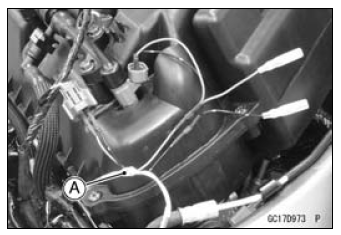
Special Tool - Measuring Adapter: 57001-1700
Secondary Fuel Injector Power Source Voltage Connections to Adapter:
For Secondary Fuel Injector #1, #2, #3, #4
Digital Meter (+) → R (injector W/R) lead
Digital Meter (–) → Battery (–) terminal
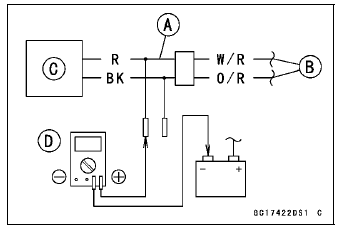
Power Source Voltage Standard: Battery Voltage for 3 seconds, and then 0 V
If the reading stays on battery voltage and never shows 0 V, check the fuel pump relay (see Relay Circuit Inspection in the Electrical System chapter).
If the fuel pump relay is normal, check the ECU for its ground and power supply (see ECU Power Supply Inspection).
If the ground and power supply are good, replace the ECU (see ECU Removal/Installation).
If there is still no battery voltage, check the fuel pump relay (see Relay Circuit Inspection in the Electrical System chapter).
If the fuel pump relay is normal, check the power source wiring (see wiring diagram in this section).
Special Tool - Hand Tester: 57001-1394
If the wiring is good, check the ECU for its ground and power supply (see ECU Power Supply Inspection).
If the ground and power supply are good, replace the ECU (see ECU Removal/Installation).
If the reading is in specification, check the output voltage (see Fuel Injector Output Voltage Inspection).
 For Primary Fuel Injectors
 Fuel Injector Output Voltage Inspection
Coolant Temperature Meter
The coolant temperature gauge indicates
temperature of the engine
coolant. The “ � symbol is displayed
if the coolant temperature meter
is selected.
A. Coolant Temperature Meter
B. Warning Indicator Light (Red)
C. “ � Symbol
If the coolant temperature is below
40°C (104°F ...
Front, Rear Wheel Rotation Difference Abnormal Inspection (Service Code b
25)
Check the following and correct the faulty part.
Incorrect Tire Pressure
Tires not recommended for the motorcycle were installed
(incorrect tire size).
Deformation of Wheel or Tire
Missing Teeth or Clogging with Foreign Matter of Sensor
Rotor (see Wheel Rotation Sensor Rotor Inspe ...
Check 3-5: Warning Indicator Light (Red LED) (Oil Pressure Warning)
Inspection
Connect the leads in the same circuit as Check 3-2.
Connect the terminal [10] to the battery (–) terminal.
Check that the oil pressure warning symbol [A] and the
warning indicator light (Red LED) [B] go on.
If the indicator light does not go on, replace the meter unit.
...